Percussion Fuze
Impact-sensitive Percussion Fuze for Mission-critical Defence Applications

About
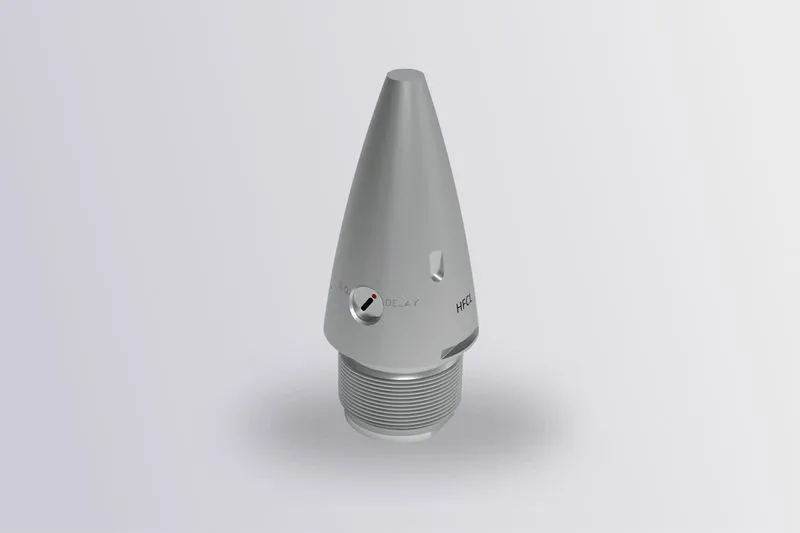
Percussion fuzes trigger the explosive charge when a munition makes contact with its target. Indigenously designed, they offer the flexibility of being programmed for either immediate detonation upon impact or delayed detonation after contact. These fuzes represent a critical component in artillery munitions, combining precision, safety, and adaptability to meet the demands of modern military applications.
Features
Benefits
Design
Designed for safety during transportation, usage, storage, and firing
Fuze Arming Time
Armed after 1000 milliseconds from launch time
Velocity & Pressure
Safe for use in the muzzle for velocity range of 180 to 1100 m/s and can withstand chamber pressure of upto 440 MPa
Shelf Life
Minimum 15 years under sheltered storage conditions
Safety
Design complies with the guidelines established by MIL-STD-1316D and STANAG 4187
Key Specifications
Applications
- Artillery ammunition for 130mm, 155mm calibres
Variants
FAQs
A percussion fuze is a type of explosive device used in munitions, triggered by direct impact or contact with a target. Upon striking the target, the fuze initiates the detonation of the explosive payload. Percussion fuzes are commonly employed in artillery shells and other projectiles, providing a simple yet effective mechanism for detonation upon impact.
The range of a percussion fuze is not defined by a specific distance but rather by the impact it experiences upon striking a target. Percussion fuzes are designed to initiate detonation upon direct impact, ensuring that the explosive payload is activated when the munition collides with its intended target, regardless of the distance traveled to reach that point.
The percussion fuze is compatible with a wide range of artillery and projectile calibers. HFCL provides variant guidance and integration support to match platform-specific dimensions, pressure tolerances, and mission requirements.