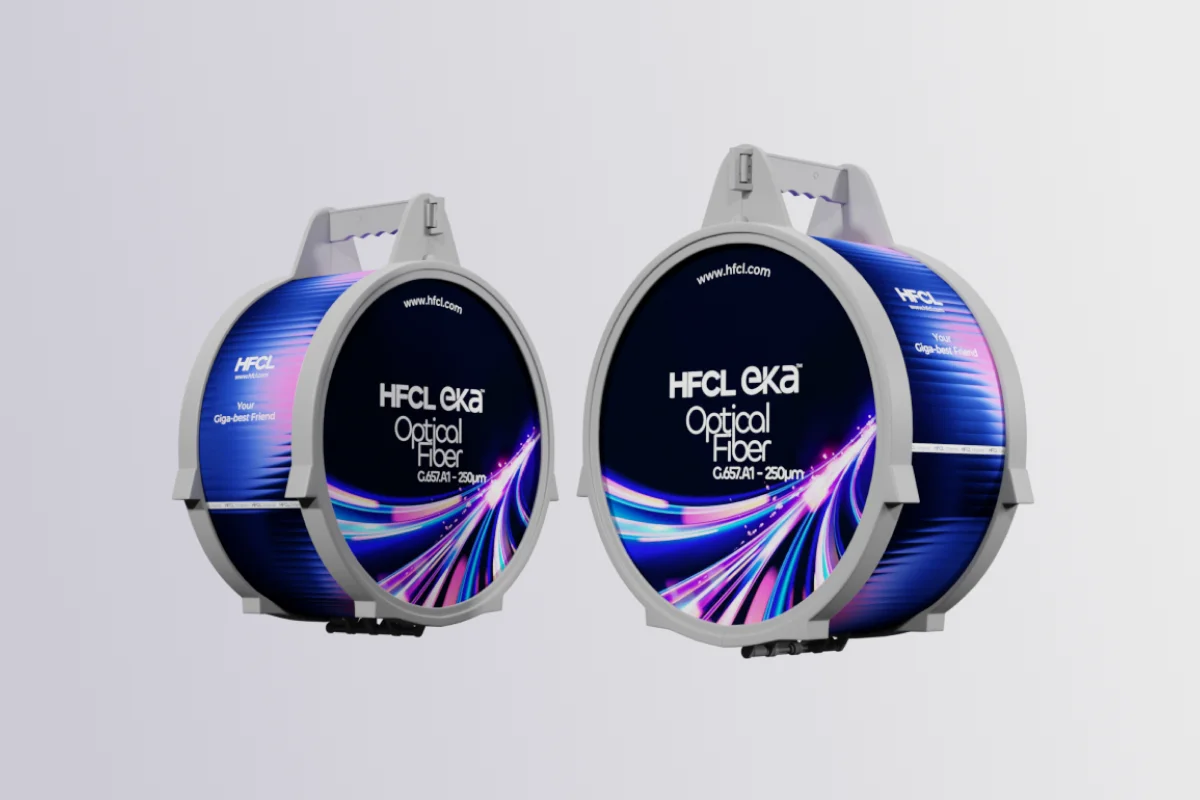
HFCL Eka Optical Fiber
Eka Fiber: Low Attenuation, Superior Bending, Built for Digital Demand

About
Unleash the future of connectivity with our low attenuation loss fiber, a cutting-edge single-mode optical fiber designed to meet evolving industry demands. Elevate your network with reduced optical losses and enhanced transmission capabilities over vast distances, all while surpassing ITU-T G.657.A1 standards. Ideal for long-haul and metro networks, access networks, FTTx deployments, and last-mile connectivity, this optical fiber ensures superior performance even in challenging conditions like macro-bend losses.
Features
Benefits
Reduced Optical Losses
Experience minimized signal attenuation. This enhances signal integrity, ensuring reliable and efficient data transmission.
Higher Transmission Capabilities
This optical fiber enables high-speed communication over extended distances, meeting the demands of modern connectivity.
Superior Performance in Macro-bend Losses
Offers resilience to macro-bend losses which ensures consistent performance, even in challenging physical conditions, guaranteeing reliability.
Single-mode Fiber Design
Tailored for single-mode applications, this fiber is ideal for long-distance communication, providing a stable and focused transmission medium.
ITU-T G.657.A1 Standards Compliance
This optical fiber meets industry standards. Thus, ensuring the fiber's quality, reliability, and compatibility with established benchmarks.
Key Specifications
Applications
- Long-haul transmission
- Metro networks
- Access networks
- FTTx networks
- Last-mile connectivity
Variants
FAQs
Low attenuation loss fiber distinguishes itself from traditional fibers by offering reduced signal loss, higher bandwidth, longer transmission distances, improved signal integrity, and enhanced overall performance in optical communication systems. These characteristics make it a preferred choice for applications where data transfer efficiency and reliability are paramount.
The characteristics of an optical fiber include its ability to transmit data through the propagation of light signals, the core and cladding composition, numerical aperture, and the attenuation loss. Optical fibers are known for their high bandwidth, low signal loss, and suitability for various applications requiring efficient data transmission over long distances.
Yes, the implementation of fiber optic technology can improve Wi-Fi performance. Fiber optics provide high-speed and reliable connectivity to the internet, which can positively impact the overall speed, stability, and bandwidth of Wi-Fi networks.