
About
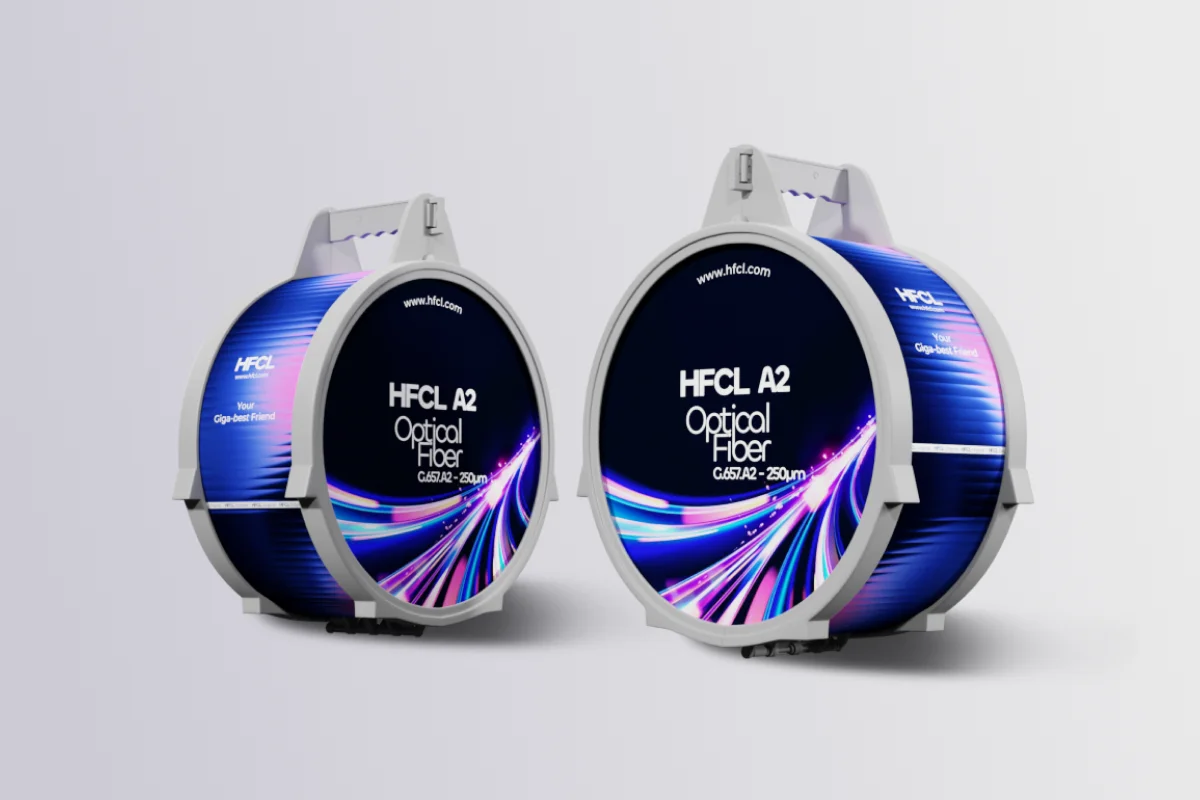
Introducing HFCL A2 optical fiber, a single-mode optical fiber engineered to redefine network connectivity. With superior bend insensitivity spanning 1260 nm to 1625 nm, it minimizes attenuation losses and enhances data transmission. The fiber excels in high-density applications, exceeding ITU – T G.657.A2 standards. Ideal for long-haul transmission, metro networks, access networks, broadband, and data centers, our flexi arch plus fiber guarantees unmatched performance. Network operators, telcos, and beyond benefit from cost-efficiency, reliability, and future-proof connectivity.
Features
Benefits
Enhanced Macro-bend Loss Performance
Experience improved performance at sharper turn radii, minimizing macro-bend loss and dispersion losses
Ideal for High-density Applications
Tailored for high-density environments, this optical fiber is the ultimate choice for data centers, ensuring seamless operations
ITU – T G.657.A2 Compliance
HFCL A2 optical fiber not only meets but exceeds ITU – T G.657.A2 standards, ensuring reliability and quality
Key Specifications
Applications
- Long-haul transmission
- Metro networks
- Access networks
- Broadband networks
- High density applications such as data centers
- Fiber optic sensing systems
Variants
FAQs
An optical fiber is a thin strand made of plastic or glass. It has a core in the center and is surrounded by a protective layer called cladding. The optical fiber working principle involves transmitting information using light particles (photons). The core and cladding's specific refractive indices make light bend at controlled angles, ensuring it stays confined during transmission. This controlled bending, known as total internal reflection, maintains signal integrity. At the fiber's end, a light-sensitive device captures the light signal, converting it back into an electronic signal for various devices like computers or televisions.
Optical fiber attenuation results from absorption, scattering, and the waveguide effect, impacting signal strength during transmission. It's measured in decibels per kilometer (dB/km) and happens due to light absorption or scattering. Impurities in the fiber absorb or scatter the light, and variations in the fiber's refractive index can cause scattering too. Over long distances, this weakening can make it challenging to maintain the original signal strength.
The term bandwidth in the context of optical fiber refers to the data-carrying capacity or the amount of information that can be transmitted over the fiber-optic cable in a given period. It is typically measured in terms of data transfer rate and is expressed in bits per second (bps) or gigabits per second (Gbps). The bandwidth of an optical fiber can vary based on several factors, including the type of fiber, the transmission equipment, and the technology used. In commercial applications, data rates of 10 Gbps, 40 Gbps, 100 Gbps, and even higher are common.