What Is Segment Routing? A Complete Guide for Modern telecom Networks.

Segment Routing is rapidly emerging as a foundational technology for modern networks. As cloud computing, AI, edge services, and 5G continue to reshape traffic patterns, operators need a more scalable and programmable way to manage network resources. Segment Routing addresses these challenges by simplifying traffic engineering while providing greater control over how traffic moves through the network. According to GSMA Intelligence, global 5G connections are expected to reach 5.5 billion by 2030, further increasing demands on network infrastructure. In this blog, we explore how Segment Routing works and why it is becoming a key building block of future-ready network architectures.
What Is Segment Routing?
Segment Routing is a modern source-routing architecture that gives network operators precise control over the path a packet takes before it even enters the network. Rather than requiring every router along the way to track information about individual traffic flows, the complete set of forwarding instructions is encoded directly into the packet at the network edge meaning the intelligence travels with the data.
The core principle: forwarding instructions travel inside the packet, not pre-distributed across the network."
These instructions are represented as Segment Identifiers, or SIDs. Each SID acts as a discrete forwarding directive, telling the network what to do with the packet at a given point along its journey whether that means traversing a specific node, following a particular link, or invoking a network service. As the packet moves hop by hop through the network, each router simply reads the next active SID and carries out the corresponding action, without needing to maintain any per-flow state of its own.
This is a fundamental departure from how traffic engineering has traditionally worked. Conventional MPLS traffic engineering depends on signalling protocols such as RSVP-TE to establish and maintain forwarding paths across every router in the network a process that introduces significant control-plane complexity and limits scalability. Segment Routing sidesteps much of this overhead by letting packets carry their own path information from source to destination. The result is a leaner, more scalable, and far more programmable architecture that reduces operational burden while giving operators granular, end-to-end control over how traffic behaves across their networks.
Why Are Networks Moving Toward Segment Routing?
For decades, MPLS served as the backbone of traffic engineering across service provider and enterprise networks alike. It gave operators reliable tools to control traffic paths, maximize network utilization, and deliver consistent services at scale. But as networks grew in size and complexity, new forces began to strain the architecture.
The rise of cloud computing, edge services, artificial intelligence, and 5G transformed network traffic from something relatively predictable into something highly dynamic. Workloads shifted constantly, latency requirements tightened, and traffic volumes surged all demanding faster, more granular responses than traditional MPLS was designed to provide.
The deeper problem lay in MPLS's control plane. Delivering traffic engineering at scale required deploying signalling protocols such as RSVP-TE and LDP alongside the core routing infrastructure. RSVP-TE, while powerful, maintains per-flow signalling state on every transit router along a path a design that becomes operationally expensive and difficult to scale as networks expand. LDP, on the other hand, lacks native traffic engineering support and introduces its own synchronization challenges with the underlying IGP. Running both protocols simultaneously as many operators did compounded the complexity further, creating what Cisco describes as an "operationally expensive" control plane that grew harder to manage over time.
The industry needed a path forward: an architecture that could deliver the same level of traffic control and path determinism that MPLS offered, but without the signalling overhead and per-flow state that made it so unwieldy at scale. Segment Routing was the answer. By encoding path information directly into the packet and distributing SIDs through existing IGP extensions such as IS-IS and OSPF with no need for separate label distribution protocols SR delivers deterministic traffic engineering with a far lighter control plane. The network core becomes stateless, new services can be introduced without touching intermediate routers, and operators gain a foundation that is genuinely built for automation and programmability.
This is why the transition to Segment Routing is not simply a technology refresh it is a structural response to the demands that modern networks now place on the infrastructure beneath them.
What Are the Core Components of a Segment Routing Network?
Although Segment Routing simplifies network operations, it relies on several key components that work together to create a highly flexible forwarding architecture. These components allow operators to define packet paths at the network edge while keeping the network core lightweight and scalable.
Understanding Network Domain Boundaries
Every Segment Routing deployment operates within an SR domain. This domain consists of all routers and network devices that understand and process Segment Routing instructions. Within this domain, different routers perform different functions. Rather than assigning every device the responsibility of calculating and maintaining forwarding paths, responsibilities are distributed across specific network roles. This separation simplifies network operations and reduces the amount of state information that must be maintained throughout the infrastructure.
Ingress Router
The ingress router serves as the entry point into the Segment Routing domain. When traffic enters the network, this router evaluates policies, determines the desired path, creates the Segment List, and attaches the necessary Segment Identifiers to the packet. Because path intelligence is concentrated at the ingress point, the network gains greater flexibility while reducing complexity elsewhere in the infrastructure.
Transit Router
Transit routers form the core of the Segment Routing network. Unlike traditional MPLS architectures that often require intermediate devices to maintain extensive path information, transit routers in a Segment Routing environment simply execute the instructions carried within the packet. Their responsibility is straightforward: read the active SID, perform the associated forwarding action, and forward the packet toward the next destination. This significantly reduces operational overhead within the network core.
Egress Router
The egress router represents the final Segment Routing device along the forwarding path. Once traffic reaches this router, Segment Routing information is removed and the packet continues toward its final destination using standard forwarding mechanisms. Together, ingress, transit, and egress routers create a forwarding framework that is both efficient and scalable.
Understanding Segment Lists
At the heart of how Segment Routing directs traffic is a concept called the Segment List an ordered sequence of instructions that defines, in advance, the exact path a packet must follow through the network. Rather than leaving each router to independently determine the next hop at every step, the Segment List encodes the desired forwarding behaviour before the packet even enters the network.
This shift has meaningful implications for operators. Because path decisions are made at the source, the network core is relieved of the need to maintain complex per-flow state or perform continuous path computation. The result is more precise control over the variables that matter most in modern networks latency, bandwidth utilization, traffic distribution, and resilience all defined upfront, not discovered hop by hop.
Understanding Segment Identifiers (SIDs)
If the Segment List is the roadmap, Segment Identifiers or SIDs are the individual directions it contains. Each SID encodes a specific forwarding instruction: where to send the packet next, which link to use, or what network function to apply along the way. By stacking multiple SIDs into a Segment List, operators can construct highly precise traffic paths tailored to specific performance, security, or policy requirements. There are three primary SID types, each offering a different level of control.
Node SID
A Node SID identifies a specific router within the network. When traffic is assigned a Node SID, the network forwards the packet toward that router using the shortest available path calculated by the Interior Gateway Protocol (IGP). Because Node SIDs are globally understood across the Segment Routing domain, they form the foundation of most deployments.
Adjacency SID
Where a Node SID defers to the IGP for path selection, an Adjacency SID overrides it entirely. An Adjacency SID is assigned to a specific physical link between two neighboring routers and is locally significant meaningful only to the router that advertises it. When applied, it forces traffic across that exact link, giving operators surgical control over the path a packet takes. This precision is particularly valuable for congestion avoidance, low-latency path enforcement, or meeting strict service-level agreement requirements where the default shortest path simply won't do.
Service SID
The Service SID extends Segment Routing beyond pure packet forwarding into the realm of network services. Assigned to a specific function provisioned at a node such as a firewall, deep packet inspection engine, load balancer, or security platform a Service SID directs traffic through that function before it continues on to its destination. This enables service function chaining: the ability to define not just the path a packet takes, but the services it passes through along the way. Like Adjacency SIDs, Service SIDs are locally significant and allow operators to build sophisticated service-aware paths without introducing additional protocol complexity.
How Does a Data Packet Move Through a Segment Routing Network?
The forwarding process in Segment Routing is fundamentally different from traditional MPLS traffic engineering. There are no signaling protocols establishing state across the network, no tunnel mesh to maintain, and no per-flow information stored at intermediate routers. Instead, the packet itself carries everything the network needs to deliver it. The journey unfolds in three distinct phases
Phase 1: Policy Evaluation and Packet Encapsulation
When traffic arrives at the network edge, the ingress router takes on the most critical role in the entire forwarding process. It evaluates applicable routing policies, performance objectives, and traffic engineering constraints such as latency bounds, bandwidth requirements, or path diversity rules and uses these inputs to determine the optimal forwarding path.
Once the path is selected, the ingress router constructs the corresponding Segment List and encodes the ordered sequence of SIDs directly into the packet header, encapsulating it in an SR tunnel before forwarding it into the network. By the time the packet leaves the ingress router, the entire forwarding strategy has already been decided. Nothing in the core needs to be consulted, configured, or signalled.
Phase 2: Transit Forwarding
As the packet traverses the network interior, each transit router performs a straightforward operation: it reads the currently active SID from the packet header, executes the corresponding forwarding instruction whether that means sending the packet toward a specific node, across a designated link, or through a network function and passes it along to the next hop.
Crucially, transit routers maintain no per-flow state and participate in no signalling exchange. They simply act on the instructions already embedded in the packet and move it forward. This stateless behaviour in the network core is what gives Segment Routing its scalability advantage adding new services or traffic paths requires no configuration changes on intermediate devices, only at the edge where the policy is defined.
Phase 3: Egress Processing and Delivery
When the packet reaches the egress router and all segments have been processed, the SR encapsulation is removed. The egress router then forwards the original traffic toward its final destination based on its IP address, just as it would any other packet. The SR header has served its purpose and is cleanly stripped away, leaving no residual state in the network.
This three-phase model encode at the edge, execute in the core, decapsulate at the exit is elegant in its simplicity. It concentrates intelligence where it belongs, at the point of entry, while keeping the network core lean, fast, and scalable. As traffic demands grow more complex and dynamic, this architecture's ability to adapt without burdening the core becomes one of its most valuable properties.

How Does Segment Routing Improve Network Efficiency?
Improving efficiency without adding complexity is one of the central promises of Segment Routing and one of the primary reasons operators are adopting it on a scale. Traditional routing protocols make forwarding decisions based on the shortest available path. This works well in simple scenarios, but at scale it creates a structural problem: some links become heavily congested while perfectly good capacity on adjacent paths sits idle. As traffic volumes grow, this imbalance drives up latency, degrades application performance, and pressures operators into expensive infrastructure expansion even when the network as a whole has sufficient capacity. Segment Routing attacks this problem directly by giving operators fine-grained, programmable control over exactly how traffic moves through the network.
Real-Time Congestion Avoidance
Congestion is among the most common causes of network performance degradation. When large volumes of traffic converge on the same links, packet delays increase, throughput drops, and user experience deteriorates consequences that conventional routing protocols are too slow to prevent. Rather than waiting for protocols to detect and react to congestion after the fact, Segment Routing enables operators to proactively steer traffic around problem areas using SR-TE policies that define explicit forwarding paths before congestion develops.
This proactive capability is especially critical for latency-sensitive workloads financial transaction systems, real-time video conferencing, cloud-hosted applications, and industrial automation platforms where even brief delays translate directly into business or operational impact. By shifting from reactive to preventive traffic management, SR-TE gives operators the tools to honour service-level commitments regardless of how traffic patterns shift.
Better Capacity Utilization
Uneven resource utilization is a persistent inefficiency in traditional networks. Some links run near saturation while others carry a fraction of their available capacity an imbalance that, over time, forces operators to invest in additional infrastructure that wouldn't be necessary if existing resources were more evenly utilized. Hyperscale cloud providers have demonstrated that by dynamically rerouting traffic, overall capacity utilization of 80% or more is achievable.
Segment Routing makes this level of utilization accessible to a broader range of operators. By enabling deliberate traffic distribution across multiple available paths, SR-TE allows operators to spread load more evenly across the network, extract greater value from existing infrastructure, and defer costly capacity upgrades not by over-provisioning, but by using what is already there more intelligently.
Faster Service Provisioning
In traditional MPLS traffic engineering environments, deploying a new service path often requires coordinated configuration changes across multiple devices throughout the network. This process is time-consuming, operationally intensive, and a source of risk in large-scale environments.
Segment Routing changes this fundamentally. Because forwarding instructions are applied at the ingress router and carried within the packet, new traffic paths can be instantiated without touching intermediate nodes. The result is faster deployment, fewer touchpoints, and a shorter path from business requirement to live service an advantage that compounds as organizations push toward greater automation and on-demand network programmability.
Reduced Control-Plane Complexity
Perhaps the most structurally significant efficiency gain is the reduction in control-plane overhead. Traditional traffic engineering requires routers throughout the network to maintain per-flow path state and participate in continuous signalling exchanges via protocols like LDP and RSVP-TE. As the network grows, so does this overhead making the system progressively harder to scale and manage.
Segment Routing eliminates much of this burden by moving path intelligence to the network edge. Because the complete forwarding strategy is encoded in the packet at ingress, intermediate routers maintain less state, perform fewer control-plane operations, and are insulated from the churn that comes with network changes. The core becomes leaner, more stable, and significantly easier to operate at scale.
What Role Do SDN Controllers and PCEs Play in Segment Routing?
Segment Routing is fully capable of operating in a distributed manner, with ingress routers computing and applying forwarding policies independently. But in large-scale deployments, operators increasingly pair SR with Software-Defined Networking controllers and Path Computation Elements (PCE) to add a layer of centralized intelligence that distributed systems alone cannot provide.
A PCE sits above the network and maintains a real-time, network-wide view topology, available bandwidth, link utilization, traffic conditions, and policy constraints that no individual router can see on its own. Using this global visibility, it calculates optimal forwarding paths and distributes the resulting Segment Lists to ingress routers via the Path Computation Element Communication Protocol (PCEP). The ingress router receives the instruction, encodes it into the packet, and the SR forwarding model handles the rest. No signalling propagates through the core.
This centralized visibility becomes especially valuable when network conditions shift quickly. Rather than waiting for distributed routing protocols to detect and converge around changes, the controller can continuously monitor and respond to conditions across the entire network in near real time including:
- Link utilization and congestion signals
- Available bandwidth per path
- End-to-end latency measurements
- Packet loss indicators
- Per-application performance requirements
When any of these metrics cross a threshold or a policy objective changes, the controller can automatically update SR-TE policies at the ingress rerouting traffic without touching a single intermediate router. The result is a network that responds to conditions as they emerge rather than after they've already caused degradation.
This architecture also represents a meaningful step toward intent-based networking. Rather than manually engineering individual traffic paths, operators define high-level business objectives minimize latency for this application, maximize throughput for that service, maintain disjoint paths for resilience and the controller determines how to translate those objectives into forwarding instructions automatically.
For operators evaluating how to deploy Segment Routing in practice, this controller-augmented model raises an immediate architectural question: which data plane should SR run on? That decision between SR-MPLS and SRv6 is one of the most consequential choices in any SR deployment.
SR-MPLS vs SRv6: Which Deployment Model Should You Choose?
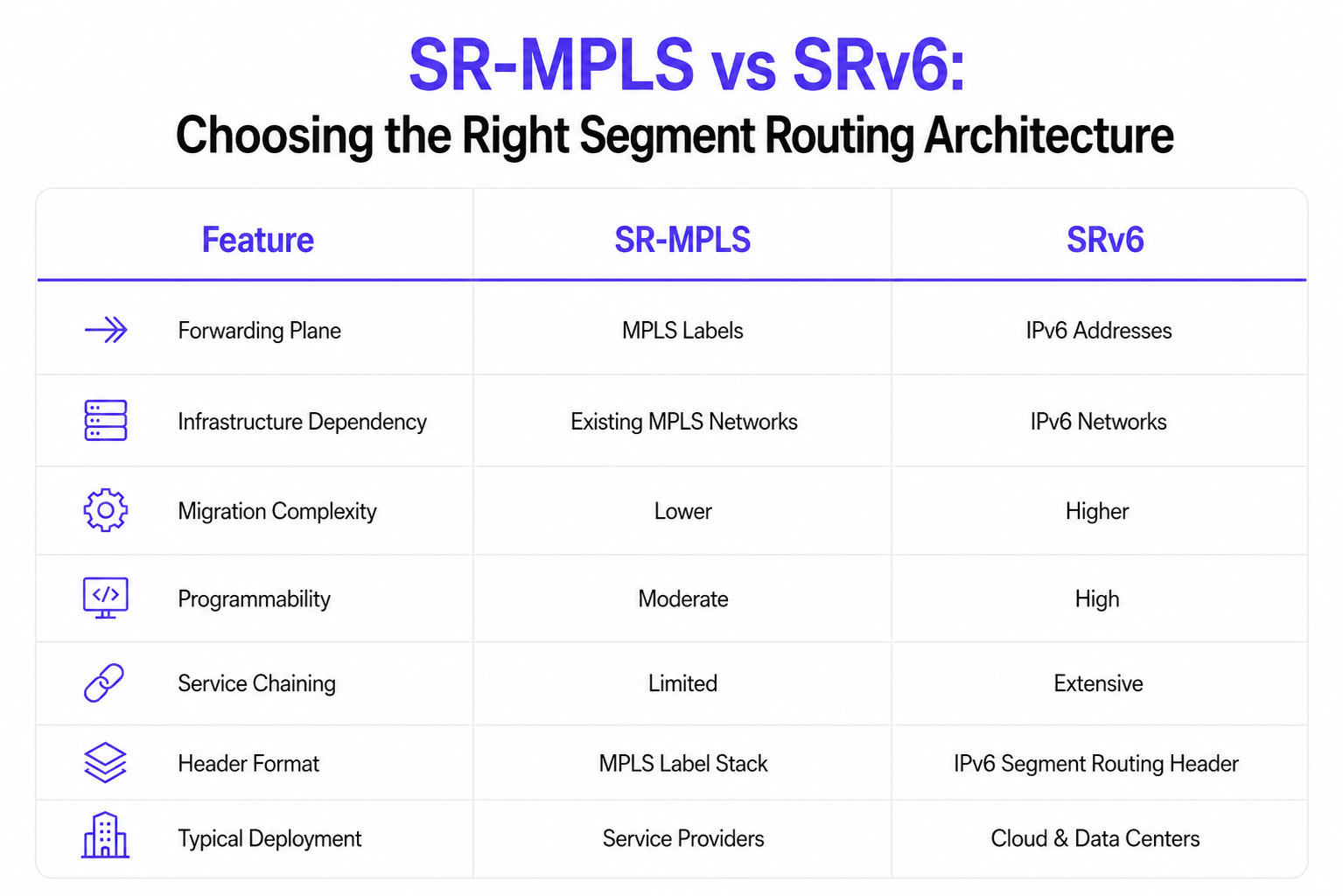
Although both SR-MPLS and SRv6 implement the same Segment Routing principles, they differ significantly in how Segment Identifiers are encoded and transported across the network.
When Does SR-MPLS Make Sense?
SR-MPLS runs on the MPLS data plane, encoding Segment Identifiers as standard MPLS labels. For organizations that already operate MPLS networks, this is a significant practical advantage Segment Routing capabilities can be introduced incrementally without replacing existing hardware or overhauling the forwarding plane. Because the data plane itself is unchanged, existing ASIC investments remain fully valid and adoption costs are comparatively low.
This makes SR-MPLS an attractive migration path for:
- Telecom operators
- Internet service providers
- Enterprise WAN environments
- Existing MPLS transport networks
The ability to modernize traffic engineering capabilities while preserving existing infrastructure and to migrate at a pace that suits the organization is precisely the kind of pragmatic continuity that large network operators require.
When Does SRv6 Make Sense?
SRv6 takes a fundamentally different approach. Rather than MPLS labels, it encodes forwarding instructions as 128-bit IPv6 addresses carried in a Segment Routing Header (SRH) appended to the IPv6 packet. This tight integration with the IPv6 stack eliminates the need for a separate MPLS layer entirely and opens up a substantially richer programming model.
Because each 128-bit SID can embed not just location information but also specific network functions or application metadata, SRv6 enables more expressive service function chaining and greater architectural flexibility than SR-MPLS can offer. It also simplifies cross-domain deployments, where IPv6's native reachability removes the need to leak host routes across autonomous system boundaries a known complexity in SR-MPLS multi-domain scenarios.
SRv6 is particularly attractive for:
- Cloud-native environments
- Hyperscale data centers
- IPv6-first deployments
- Advanced service chaining architectures
It does carry one notable trade-off: the larger SRH introduces additional header overhead compared to compact MPLS labels, which can affect bandwidth efficiency for small packets. However, the industry has responded with compressed SID formats such as micro-SID (uSID), which packs multiple SIDs into a single 128-bit field and significantly reduces this overhead making SRv6 increasingly viable even in performance-sensitive environments.
How Segment Routing Supports Cloud, AI, and 5G Networks
The rapid adoption of cloud computing, artificial intelligence, and 5G services is one of the biggest reasons Segment Routing has gained momentum across the industry. These technologies place unique demands on network infrastructure that traditional routing approaches often struggle to accommodate.
Supporting Cloud Connectivity
Cloud environments are inherently dynamic. Applications move between regions, workloads scale up and down, and traffic patterns change continuously. Maintaining optimal connectivity across this environment requires a routing architecture capable of adapting quickly. Segment Routing enables operators to define efficient traffic paths between data centers, cloud regions, and enterprise locations while maintaining predictable performance and efficient resource utilization.
Supporting AI Workloads
Artificial intelligence applications generate traffic patterns that differ significantly from traditional enterprise applications. Large AI training environments require constant communication between compute clusters, storage systems, and processing resources. These workloads often generate massive east-west traffic flows that can overwhelm traditional routing architectures. Segment Routing allows operators to engineer predictable, low-latency paths for AI traffic while avoiding network bottlenecks. This helps maintain consistent performance across highly distributed AI infrastructures.
Supporting Network Slicing in 5G
5G networks must support multiple services with different performance requirements. A mobile gaming application, an industrial automation system, and a remote healthcare platform may all operate on the same physical infrastructure while requiring very different network characteristics. Segment Routing enables operators to create deterministic traffic paths that align with the requirements of individual network slices. This allows multiple services to coexist efficiently while maintaining their specific performance objectives.
Supporting Edge Computing
Edge computing moves applications and processing resources closer to end users. While this improves responsiveness, it also increases the number of locations where traffic must be managed. Segment Routing provides the flexibility required to connect distributed edge environments while maintaining efficient traffic engineering and simplified operations. As adoption grows, several misconceptions about Segment Routing continue to circulate throughout the industry. Understanding the reality behind these myths is important for organizations evaluating the technology.
How Do Artificial Intelligence and Segment Routing Work Together?
Artificial intelligence is rapidly becoming a critical component of modern network operations. As networks become larger and more dynamic, manually managing traffic paths, troubleshooting performance issues, and optimizing resource utilization becomes increasingly difficult. Segment Routing provides the programmable forwarding framework needed for automation, while AI provides the intelligence required to make dynamic decisions based on real-time network conditions. Together, these technologies create the foundation for self-optimizing networks.
Predictive Traffic Engineering
Traditional traffic engineering is often reactive. Network operators identify congestion after performance begins to degrade and then take corrective action. Artificial intelligence changes this approach by analyzing streaming telemetry data from routers, switches, and transport infrastructure. Machine learning models can detect patterns that indicate future congestion before users experience service degradation. When integrated with Segment Routing, AI systems can automatically calculate alternative forwarding paths and adjust traffic flows before congestion becomes visible to applications or end users.
Intent-Based Network Operations
One of the long-term goals of network automation is intent-based networking. Instead of manually configuring traffic engineering policies, operators define business objectives and allow the network to determine how those objectives should be achieved.
For example, an operator might define a requirement such as:
"Critical financial applications must maintain latency below 10 milliseconds."
Rather than manually engineering traffic paths, an AI-driven Segment Routing system can continuously monitor network conditions and dynamically adjust forwarding policies to maintain the required performance level.
This reduces operational effort while improving service consistency.
Supporting AI Infrastructure
The relationship between AI and Segment Routing is not limited to network automation. AI workloads themselves create significant networking challenges. Large AI training environments generate enormous amounts of traffic between GPU clusters, storage platforms, and inference systems. Maintaining predictable performance within these environments requires precise traffic engineering and efficient resource utilization. Segment Routing enables operators to create optimized forwarding paths for AI traffic without introducing additional complexity throughout the network core. This makes it increasingly valuable as AI adoption continues to accelerate across industries. As automation, cloud computing, and AI continue to reshape network infrastructure, Segment Routing is expected to play an even greater role in future architectures.
What Is the Future of Segment Routing?
The networking industry is moving toward a future defined by automation, programmability, and intelligent infrastructure. Segment Routing aligns closely with these trends because it provides a simplified forwarding architecture that can scale efficiently while supporting advanced traffic engineering capabilities. Several technology shifts are expected to accelerate Segment Routing adoption over the next decade.
Expansion of Edge Computing
As applications move closer to users, the number of locations participating in network operations will continue to grow. Edge computing environments require flexible routing architectures capable of directing traffic efficiently across highly distributed infrastructures. Segment Routing's ability to define explicit forwarding paths makes it particularly well suited for supporting these environments.
Growth of 5G and Future 6G Networks
5G networks already depend heavily on automation, network slicing, and traffic engineering. As deployments expand and future 6G architectures emerge, networks will require even greater flexibility and scalability. Because Segment Routing provides deterministic forwarding behavior without excessive signaling complexity, it is expected to remain a foundational technology for next-generation mobile transport networks.
Increased Adoption of AI-Driven Networking
Artificial intelligence will continue transforming network operations through predictive analytics, automated optimization, and intent-based management. Segment Routing provides the programmable infrastructure needed to support these capabilities. As AI becomes more deeply integrated into network management platforms, the combination of AI and Segment Routing will help create increasingly autonomous network environments.
Cloud-Native Network Architectures
Cloud-native networking emphasizes automation, scalability, and software-driven operations. Segment Routing aligns naturally with these principles by simplifying traffic engineering and reducing operational overhead. As organizations continue adopting cloud-native architectures, Segment Routing is expected to become a preferred approach for managing transport infrastructure across cloud, edge, and enterprise environments. Taken together, these trends suggest that Segment Routing is not simply an incremental improvement to existing routing technologies. Instead, it represents a long-term architectural shift toward more intelligent, scalable, and programmable networks.
Conclusion
As networks continue to expand under the demands of cloud, AI, edge computing, and 5G, operators need routing architectures that deliver scalability, automation, and efficient traffic management. Segment Routing addresses these challenges through a simpler and more programmable approach to traffic engineering, helping organizations build more agile and future-ready networks. To support this evolution, HFCL's DCR1100 IP/MPLS router portfolio incorporates advanced Segment Routing capabilities, enabling operators to simplify operations, optimize network performance, and prepare for the next generation of digital connectivity.
FAQ
Segment Routing simplifies network traffic engineering by reducing the dependence on multiple signaling protocols and complex path management mechanisms. Instead of requiring routers throughout the network to maintain extensive forwarding state information, Segment Routing places path intelligence at the network edge and carries forwarding instructions within the packet itself. This approach reduces operational complexity while improving scalability. It also gives operators greater control over how traffic moves through the network, making it easier to optimize bandwidth utilization, avoid congestion, and meet application-specific performance requirements. Another major advantage is automation. Segment Routing integrates effectively with SDN controllers, telemetry platforms, and intent-based networking systems, allowing traffic paths to be adjusted dynamically as network conditions change. These capabilities help organizations build more efficient, flexible, and scalable networks while simplifying day-to-day network operations.
Cloud computing, artificial intelligence, and 5G services generate highly dynamic traffic patterns that traditional routing methods often struggle to manage efficiently. Cloud environments require traffic to move seamlessly between data centers, regions, and service locations, while AI workloads generate large volumes of east-west traffic between compute and storage resources. Similarly, 5G networks require predictable traffic paths to support latency-sensitive applications and network slicing. Segment Routing addresses these challenges by enabling operators to define explicit forwarding paths based on performance, bandwidth, or policy requirements. This allows traffic to be directed more intelligently across the network instead of relying solely on shortest-path routing decisions. The result is better resource utilization, improved application performance, lower latency, and greater operational flexibility. These capabilities make Segment Routing particularly valuable in modern environments where traffic demands constantly change.
SR-MPLS and SRv6 are two implementations of the Segment Routing architecture, but they use different forwarding mechanisms. SR-MPLS uses MPLS labels as Segment Identifiers (SIDs) and is often deployed in networks that already operate MPLS infrastructure. Because it builds upon existing MPLS environments, organizations can often introduce Segment Routing capabilities without major infrastructure changes. SRv6, on the other hand, uses IPv6 addresses to represent forwarding instructions and carries them within the IPv6 Segment Routing Header. This approach provides greater programmability and enables advanced capabilities such as service chaining and network automation. While SR-MPLS is commonly adopted by service providers and existing MPLS operators, SRv6 is gaining popularity in cloud-native, hyperscale, and IPv6-first environments. Both approaches follow the same Segment Routing principles but are optimized for different deployment strategies and network requirements.
As networks continue to evolve, operators are increasingly focused on automation, scalability, and operational simplicity. Emerging technologies such as edge computing, artificial intelligence, cloud-native applications, and future mobile network generations require more flexible traffic engineering capabilities than traditional approaches can efficiently provide. Segment Routing addresses these needs by simplifying forwarding operations while enabling highly programmable traffic control. Its ability to integrate with SDN controllers, telemetry systems, and AI-driven automation platforms makes it well suited for modern network management strategies. Additionally, Segment Routing reduces control-plane complexity and supports efficient use of network resources, helping operators scale their infrastructure without significantly increasing operational overhead. As organizations continue investing in digital transformation initiatives, Segment Routing is expected to play a central role in building intelligent, automated, and future-ready network architectures capable of supporting next-generation applications and services.