What Is Intermediate System to Intermediate System (IS-IS)? A Complete Guide for Telecom Networks
Every packet that moves through a service provider network needs a map before it can move at all. That map is built by an Interior Gateway Protocol (IGP), and inside almost every large telecom backbone, that IGP is IS-IS. According to GSMA Intelligence, global 5G connections are projected to reach 5.5 billion by 2030, up from 1.6 billion at the end of 2023, a trajectory that keeps adding pressure on the transport networks carrying that traffic. Behind the scenes, IS-IS is one of the two link-state protocols (alongside OSPF) that most of those transport networks depend on to calculate loop-free paths, and it is also the protocol that carries Segment Routing across the operator core. This guide explains what IS-IS is, how it works, why service providers have leaned on it for more than three decades, and how it fits into modern 5G, cloud, and Segment Routing architectures.
What Is IS-IS?
IS-IS, short for Intermediate System to Intermediate System, is a link-state interior gateway protocol that routers use to exchange topology information and calculate the shortest path to every destination inside a routing domain. The protocol originated in the OSI world, where a router is called an “Intermediate System” (as opposed to an end host, or “End System”), which is where the name comes from.
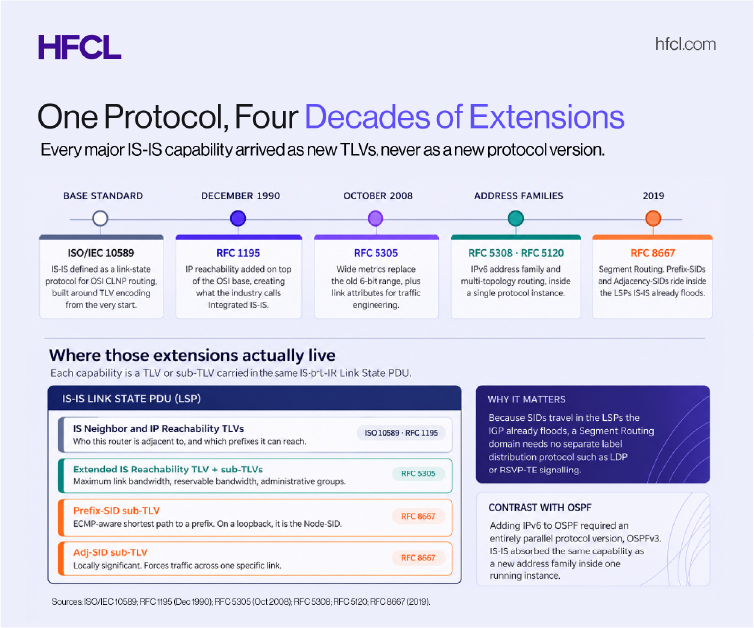
IS-IS was originally standardized as ISO/IEC 10589 to route the OSI Connectionless Network Protocol (CLNP). The Internet Engineering Task Force later extended it to carry IP routing information in RFC 1195, published in December 1990, which describes IS-IS as an integrated routing protocol that can serve as an interior gateway protocol (IGP) for both TCP/IP and OSI environments. That extension, often called Integrated IS-IS, is what turned a CLNP-only protocol into the IGP that now underpins most large telecom and internet backbones. Subsequent IETF documents added IPv6 support and multi-topology routing, so a single instance of the protocol can carry IPv4, IPv6, and OSI reachability information at once.
Because IS-IS runs directly over the data link layer instead of over IP, it does not depend on IP addressing to form adjacencies or flood updates. That single architectural choice explains much of why the protocol has stayed relevant across four decades of network redesigns, from pure CLNP networks to dual-stack IPv4/IPv6 cores running Segment Routing today.
Why Do Telecom Networks Still Rely on IS-IS?
Enterprise networks tend to run OSPF because it is widely taught, well documented, and deeply integrated with IP. Service provider cores tend to run IS-IS instead, and the reasons are structural rather than a matter of habit.
It is protocol-independent by design. IS-IS was built to carry OSI Network Service Access Point (NSAP) addressing before IP was added, so extending it to a new address family or a new capability is a matter of defining new Type-Length-Value (TLV) fields, not redesigning the base protocol. That is exactly the mechanism IS-IS used to add IPv6 support and, later, Segment Routing.
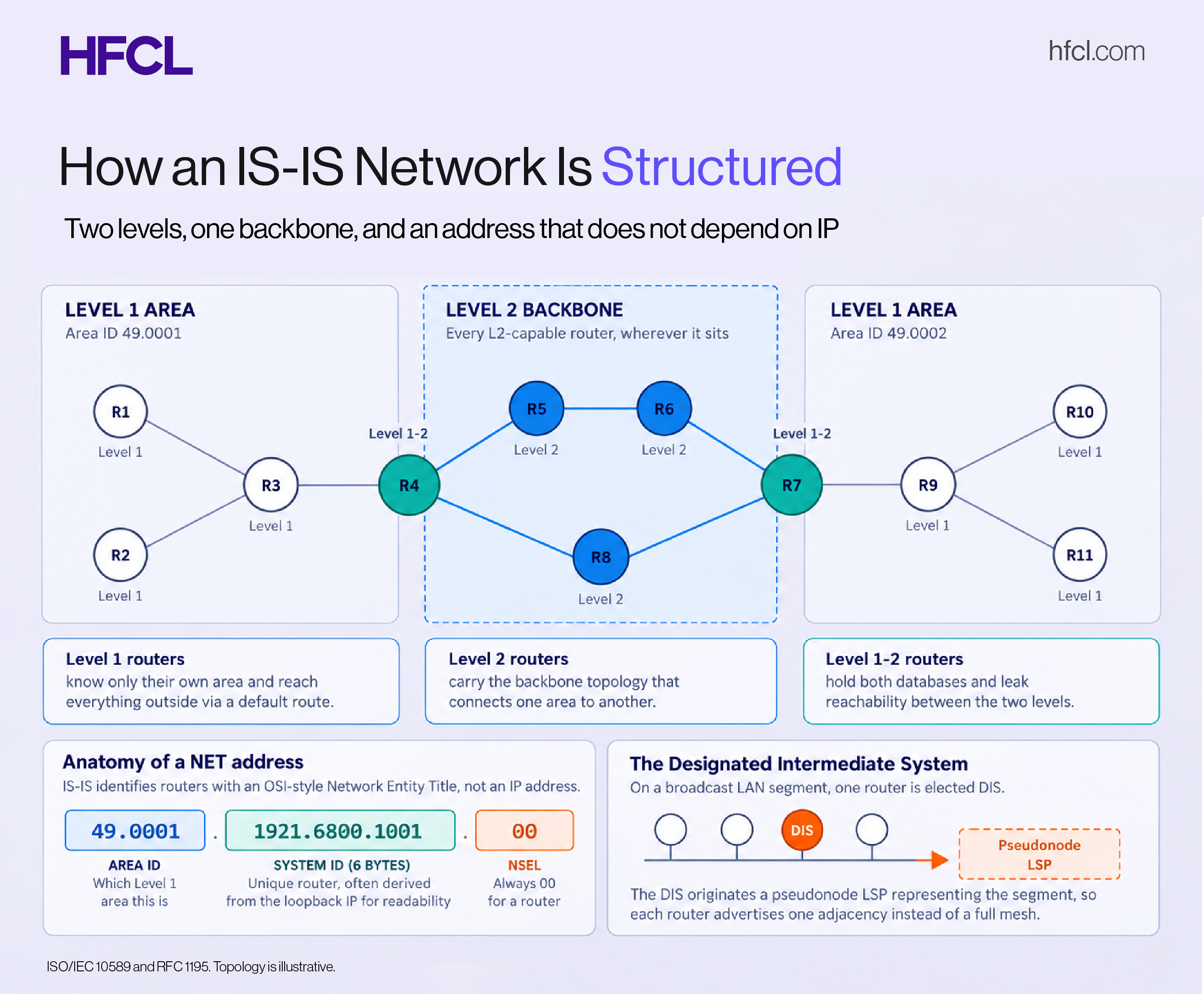
Its hierarchy is simpler to operate at scale. IS-IS uses a two-level hierarchy: Level 1 for intra-area routing and Level 2 for inter-area and backbone routing. A router can be Level 1, Level 2, or both (Level 1-2), and the backbone is simply the set of Level 2-capable routers and the links between them, wherever they happen to sit. OSPF, by contrast, requires every area to attach to a single, rigidly defined Area 0. For flat, meshed service provider cores, the IS-IS model tends to be easier to grow without re-architecting the backbone.
Large-scale deployment created a feedback loop. Because major service providers standardized on IS-IS for their backbones, router vendors invested heavily in tuning and scaling their IS-IS implementations, which in turn reinforced its position as the default choice for new service provider deployments. Networking training resources such as Cisco's IS-IS configuration guide and independent IGP comparisons consistently describe IS-IS as the more common IGP in service provider and large-scale backbone environments, while OSPF remains the more common choice in enterprise campuses and branch networks where broad tooling familiarity matters more than raw scale.
It carries the extensions modern networks need. Traffic engineering (RFC 5305), IPv6 (RFC 5308), multi-topology routing (RFC 5120), and Segment Routing (RFC 8667) were all added to IS-IS as TLV extensions without breaking the base protocol. That extensibility is a direct product of the protocol's original design for a multi-protocol OSI environment.
None of this means OSPF is a poor choice. Many enterprise WANs, data center fabrics, and multi-vendor environments run OSPF successfully, and either protocol can scale with a disciplined design. The distinction is about fit: IS-IS was built for exactly the flat, high-node-count, multi-protocol backbone that defines a modern telecom core.
Core Architecture of an IS-IS Network
IS-IS organizes a routing domain around addressing, hierarchy, and a small set of router roles. Understanding these pieces is a prerequisite to understanding how the protocol actually moves routing information.
NSAP Addressing and the Network Entity Title
Every IS-IS router is identified by a Network Entity Title (NET), an OSI-style address rather than an IP address. A NET is built from three parts: an Area ID that identifies the router's Level 1 area, a System ID (typically six bytes, often derived from a router's loopback IP address for readability) that uniquely identifies the router within the domain, and a one-byte NSAP Selector (NSEL) that is always set to 00 for a router. This OSI-derived addressing scheme is the part of IS-IS that most confuses engineers who learned routing on IP-only protocols, but it is also what allows the protocol to remain independent of the IP address family it happens to be carrying.
Level 1, Level 2, and Level 1-2 Routers
IS-IS divides a network into areas using a two-level hierarchy:
- Level 1 routers hold a detailed topology of their own area and reach destinations outside the area through the nearest Level 1-2 router, using a default route.
- Level 2 routers hold the backbone topology, connecting areas to each other.
- Level 1-2 routers participate in both levels, maintaining a Level 1 database for their local area and a Level 2 database for the backbone, and they are the ones that leak reachability information between the two.
This two-database model is simpler than OSPF's five link-state advertisement types, and it is one reason IS-IS flooding tends to converge quickly across large numbers of routers.
The Designated Intermediate System (DIS)
On broadcast (multi-access) network segments, IS-IS elects a Designated Intermediate System, the equivalent of OSPF's Designated Router, to reduce the number of adjacencies that must be maintained. The DIS originates a pseudonode Link State Protocol Data Unit (LSP) representing the segment, so every router on the LAN reports one adjacency to the pseudonode instead of a full mesh of adjacencies to every neighbor. Unlike OSPF's DR election, IS-IS DIS election is preemptive: a router with a higher configured priority that joins the segment later will take over the DIS role, which network engineers deliberately tune to avoid unnecessary re-elections on production links.
How Does IS-IS Build a Routing Table?
IS-IS follows the same general life cycle as any link-state protocol: discover neighbors, flood topology information, and run a shortest-path calculation. The details of how it does this are what set it apart.
Phase 1: Neighbor Discovery and Adjacency Formation
Routers running IS-IS exchange Hello Protocol Data Units (IIHs) to discover neighbors and form adjacencies. Point-to-point links use one Hello type, while broadcast (LAN) segments use separate Level 1 and Level 2 Hello types, since a segment can carry both kinds of adjacency simultaneously. Once two routers agree on shared parameters, such as area membership for a Level 1 adjacency, the adjacency comes up and the routers begin exchanging topology data.
Phase 2: Link State Flooding
Each router describes its own links, neighbors, and reachable prefixes in one or more Link State Protocol Data Units (LSPs) and floods them to every other router at the same level. Every router that hears an LSP re-floods it to its other neighbors, so the LSP eventually reaches every router in the level. Sequence numbers and checksums keep the flooding loop-free and ensure every router in a level converges on an identical Link State Database (LSDB) for that level.
Phase 3: Shortest Path Calculation
Once a router has a complete LSDB for its level, it runs Dijkstra's Shortest Path First (SPF) algorithm against that database to compute the loop-free shortest path to every other node and prefix. Because IS-IS supports partial or incremental SPF recalculation when only part of the topology changes, rather than always recomputing the full tree, well-tuned deployments can converge quickly after a link or node failure. The results of the SPF calculation are installed into the router's routing table (RIB) and, from there, into the forwarding table used to switch packets.
IS-IS vs. OSPF: How Do the Two IGPs Compare?
Both protocols are link-state IGPs that use Dijkstra's algorithm, and either one can run a large, well-designed network. The practical differences show up in addressing, hierarchy, and extensibility.
Neither protocol is strictly superior. The choice generally comes down to the shape of the network and the team's operational familiarity: flat, homogeneous, high-scale cores tend to favor IS-IS, while networks that need OSPF's wide vendor and tooling ecosystem, or that already have OSPF operational expertise in house, tend to stay with it.
From Narrow Metrics to Traffic Engineering: How IS-IS Extensions Evolved
The original IS-IS metric, as defined for CLNP routing, packed the link cost into a 6-bit field, capping the usable range at 0 to 63. That was workable for the OSI networks IS-IS was designed for, but it left almost no room for the kind of fine-grained traffic engineering that modern IP/MPLS backbones need.
RFC 5305, published in October 2008, addressed this by defining a new Extended IS Reachability TLV and a wide metric with a much larger dynamic range, along with sub-TLVs for link attributes such as maximum link bandwidth, maximum reservable bandwidth, and administrative (color) groups. Those attributes feed a router's traffic engineering database, which constrained shortest-path-first (CSPF) computations use to build explicit label-switched paths under protocols like RSVP-TE. In effect, RFC 5305 is what turned IS-IS from a pure reachability protocol into a source of the link-state data that traffic-engineered MPLS networks depend on.
How IS-IS Powers Segment Routing
Segment Routing's core promise is a network core that stays stateless while still supporting deterministic traffic engineering, and the mechanism that makes this possible is the same TLV extensibility that has defined IS-IS since RFC 1195. RFC 8667, IS-IS Extensions for Segment Routing, defines the sub-TLVs that let an IS-IS router advertise Segment Identifiers (SIDs) alongside its normal reachability information, so that SR path information can be distributed using the IGP a network already runs, with no separate signaling protocol required.
Two SID types are advertised directly through these IS-IS extensions:
- The Prefix-SID, carried in the Prefix-SID sub-TLV, is attached to a reachable prefix and represents an ECMP-aware shortest path to that prefix as computed by the IGP. A Prefix-SID attached to a router's loopback address becomes that router's Node-SID.
- The Adjacency-SID, carried in the Adj-SID sub-TLV, is attached to a specific link between two neighboring routers and is locally significant to the router that advertises it, giving operators the ability to force traffic across an exact link.
Because these SIDs ride inside the same LSPs that IS-IS already floods for basic reachability, a Segment Routing domain does not need a parallel label distribution protocol. This is also why the choice of IGP matters for an SR deployment: SR-MPLS and SRv6 both depend on the underlying IGP, whether that is IS-IS or OSPF, to distribute the SIDs that make source-routed forwarding possible in the first place. HFCL's overview of Segment Routing covers how SIDs, Segment Lists, and SR-MPLS versus SRv6 fit together once that IGP foundation is in place.
IS-IS in 5G, Cloud, and AI-Driven Transport Networks
5G transport networks add cell sites, mid-haul aggregation points, and edge compute locations at a pace that earlier mobile generations did not require, and every new node has to be reachable within the same converged IGP topology. IS-IS's flat, level-based hierarchy and its ability to carry IPv4, IPv6, and Segment Routing information within a single protocol instance make it well suited to a topology that keeps adding nodes without a redesign of the addressing plan.
The same characteristics apply beyond the mobile network. Data center interconnect, cloud on-ramp connectivity, and low-latency edge compute links all depend on a converged IGP core to reach new sites reliably as they come online. Because IS-IS integrates Segment Routing directly through its own TLVs rather than a bolt-on protocol, operators building SR-MPLS or SRv6 traffic engineering into their 5G and cloud transport layers can add that capability by extending an IGP they already run, rather than deploying an additional control-plane protocol.
Deployment Considerations for IS-IS
Running IS-IS well at scale involves a handful of design decisions that matter more as a network grows:
- Area planning. Because IS-IS areas are more flexible than OSPF's Area 0 model, operators still need a deliberate area boundary plan; flexibility does not remove the need for discipline in where Level 1 areas end and the Level 2 backbone begins.
- Circuit type selection. Point-to-point circuits avoid DIS election entirely and are frequently preferred on core links for that reason, while broadcast circuit type remains relevant on genuine multi-access LAN segments.
- Metric style. New deployments should use wide metrics from RFC 5305 rather than the original narrow metric, both for the larger dynamic range and because wide metrics are a prerequisite for advertising the traffic engineering and Segment Routing sub-TLVs described above.
- Fast convergence. Features like Bidirectional Forwarding Detection (BFD) and Loop-Free Alternates (LFA), including Topology-Independent LFA (TI-LFA) for Segment Routing networks, are commonly paired with IS-IS to bring failure detection and reroute times down to sub-second levels on service provider cores.
Frequently Asked Questions
Is IS-IS an IP protocol?
No. IS-IS runs directly over the data link layer rather than over IP, which is one of its defining architectural differences from OSPF. IP support was added on top of the base OSI protocol by RFC 1195 in 1990, and the protocol now carries IPv4, IPv6, and OSI reachability information within the same instance.
Why do most large telecom and internet backbones use IS-IS instead of OSPF?
IS-IS was designed as a multi-protocol OSI routing protocol from the start, so it extends to new address families and capabilities, such as IPv6 and Segment Routing, through new TLVs rather than a parallel protocol version. Its two-level hierarchy is also less rigid than OSPF's single Area 0 backbone requirement, which suits the flat, high-node-count cores common in service provider networks. OSPF remains a strong, widely supported choice, particularly in enterprise networks where broad tooling familiarity is a priority.
How does IS-IS relate to Segment Routing?
RFC 8667 defines IS-IS extensions for Segment Routing that let a router advertise Prefix-SIDs and Adjacency-SIDs inside the same Link State Protocol Data Units it already floods for basic reachability. This lets an SR-MPLS or SRv6 deployment distribute Segment Identifiers using the IGP a network already runs, without a separate label distribution protocol.
What is the difference between Level 1 and Level 2 in IS-IS?
Level 1 routing handles intra-area topology and reachability, while Level 2 routing handles the backbone that connects areas together. A router can operate as Level 1 only, Level 2 only, or both (Level 1-2), and Level 1-2 routers are responsible for leaking reachability information between the two levels.
Does HFCL's DCR 1100 router support IS-IS?
Yes. According to HFCL's published DCR 1100-X120 data sheet, the platform supports Intermediate System to Intermediate System (IS-IS) for both IPv4 and IPv6 routing, IS-IS-based IP Fast Reroute (LFA and Remote LFA), and IS-IS extensions for Segment Routing, including SR-MPLS, SR-TE, and Topology-Independent LFA. Specifications vary by model and software release, so operators should confirm exact feature support against the current data sheet for the platform they are deploying.
Conclusion
IS-IS has stayed at the center of service provider routing for more than three decades because its core design decision, carrying routing information as extensible TLVs over the data link layer rather than over IP, turned out to be exactly the right foundation for a protocol that would eventually need to support IPv6, traffic engineering, and Segment Routing without a redesign. As 5G transport, cloud interconnect, and edge networks keep adding nodes and demanding more deterministic traffic control, that same extensibility is what lets IS-IS keep pace. HFCL's DCR 1100 IP/MPLS router portfolio supports IS-IS for both IPv4 and IPv6, alongside the IS-IS Segment Routing extensions that let operators layer SR-MPLS traffic engineering onto the IGP their network already runs.
FAQ
No. IS-IS runs directly over the data link layer rather than over IP, which is one of its defining architectural differences from OSPF. IP support was added on top of the base OSI protocol by RFC 1195 in 1990, and the protocol now carries IPv4, IPv6, and OSI reachability information within the same instance.
IS-IS was designed as a multi-protocol OSI routing protocol from the start, so it extends to new address families and capabilities, such as IPv6 and Segment Routing, through new TLVs rather than a parallel protocol version. Its two-level hierarchy is also less rigid than OSPF's single Area 0 backbone requirement, which suits the flat, high-node-count cores common in service provider networks. OSPF remains a strong, widely supported choice, particularly in enterprise networks where broad tooling familiarity is a priority.
RFC 8667 defines IS-IS extensions for Segment Routing that let a router advertise Prefix-SIDs and Adjacency-SIDs inside the same Link State Protocol Data Units it already floods for basic reachability. This lets an SR-MPLS or SRv6 deployment distribute Segment Identifiers using the IGP a network already runs, without a separate label distribution protocol.
Level 1 routing handles intra-area topology and reachability, while Level 2 routing handles the backbone that connects areas together. A router can operate as Level 1 only, Level 2 only, or both (Level 1-2), and Level 1-2 routers are responsible for leaking reachability information between the two levels.
Yes. According to HFCL's published DCR 1100-X120 data sheet, the platform supports Intermediate System to Intermediate System (IS-IS) for both IPv4 and IPv6 routing, IS-IS-based IP Fast Reroute (LFA and Remote LFA), and IS-IS extensions for Segment Routing, including SR-MPLS, SR-TE, and Topology-Independent LFA. Specifications vary by model and software release, so operators should confirm exact feature support against the current data sheet for the platform they are deploying.
