Spine-Leaf Architecture and the Rise of AI Data Centers: Why the Optical Layer Matters More Than Ever

Artificial intelligence is fundamentally changing how data centers are designed.
Traditional enterprise workloads generated predictable traffic between users and applications. AI workloads are different. Large language models, distributed training clusters, real-time inference, and hyperscale computing require thousands of GPUs to exchange massive volumes of data continuously. In this environment, the network is no longer just an interconnect. It directly influences application performance, scalability, and data center infrastructure efficiency.
This shift has accelerated the adoption of Spine-Leaf architectures across hyperscale and AI data centers. While much of the industry discussion focuses on high-performance switches and networking protocols, an equally critical layer often receives less attention. The physical optical infrastructure carrying this traffic ultimately determines how efficiently these data center networks perform.
This article explores why Spine-Leaf architectures have become the preferred network design for modern data centers and why the optical layer is becoming a strategic differentiator for high-capacity, high-speed enterprise data center and hyperscale data center environments.
Why Traditional Data Center Networks Are No Longer Enough
For years, enterprise data centers relied on a three-tier network architecture consisting of Core, Distribution, and Access layers.
In this design, application traffic primarily flowed between users and servers. This pattern, commonly known as North-South traffic, worked well for web applications, enterprise software, and traditional client-server environments inside a single data center.
A typical transaction involved a user requesting data from an application server, which then communicated with a database before sending the response back to the user.
As AI workloads became mainstream, this traffic pattern changed completely.
Modern AI clusters consist of hundreds or even thousands of GPUs working together simultaneously. During model training, every GPU continuously exchanges parameters, gradients, and intermediate results with many other GPUs across the cluster.
Instead of traffic flowing into and out of the data center, most communication now happens between servers inside the data center. This East-West traffic is significantly more bandwidth-intensive and latency-sensitive than traditional workloads.
When this communication passes through multiple network layers, oversubscription and congestion become major bottlenecks. Even small increases in latency can extend AI training times and reduce overall GPU utilization.
This challenge is even more visible in cloud data centers operated by providers like Amazon Web Services, where global scale demands consistent performance across distributed infrastructure.
Understanding Spine-Leaf Architecture
- Spine-Leaf architecture simplifies the data center network into two layers.
- The Leaf layer connects directly to servers, storage systems, and GPU clusters.
- The Spine layer forms the high-speed backbone that interconnects every Leaf switch.
Unlike traditional hierarchical networks, every Leaf switch connects to every Spine switch, creating multiple parallel paths across the network.
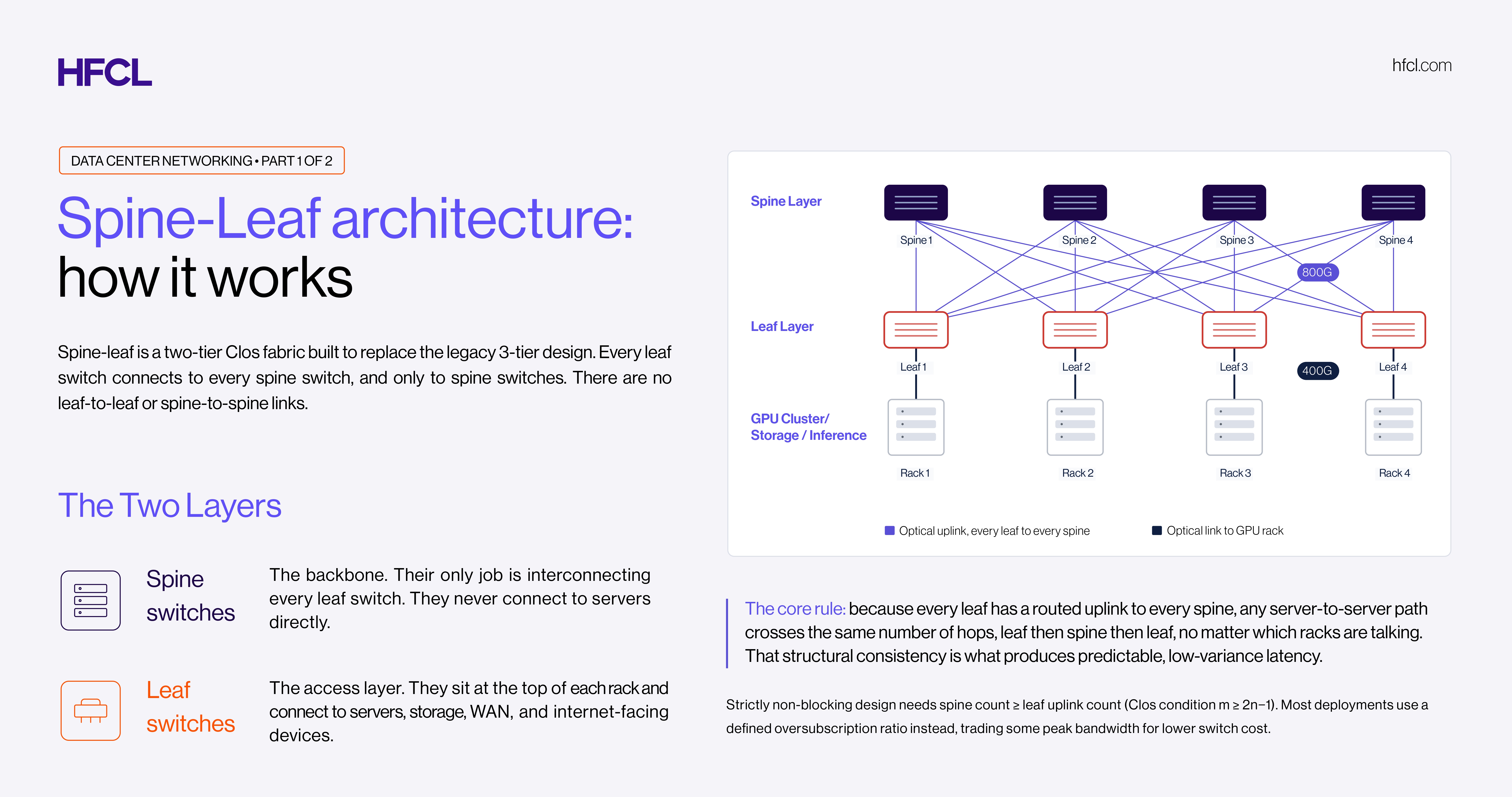
This architecture offers two significant advantages.
First, every server communicates through a predictable number of network hops, resulting in consistent low latency across the entire modern data center network.
Second, multiple equal-cost paths distribute traffic efficiently, allowing the network to scale horizontally as additional racks and compute resources are deployed.
This design has become the preferred architecture for hyperscalers, cloud providers, AI infrastructure operators, and modern enterprise data centers, including edge data centers that require distributed compute closer to users.
A Practical Example
Consider an AI training cluster with 2,000 GPUs distributed across multiple racks.
Each GPU continuously exchanges data with thousands of others during distributed model training.
In a traditional three-tier architecture, traffic traverses several network layers before reaching its destination. As traffic volumes increase, bottlenecks emerge within aggregation layers, reducing throughput and increasing latency.
In a Spine-Leaf architecture, every rack connects to Leaf switches, and every Leaf connects to all Spine switches. The result is predictable latency, improved bandwidth utilization, and the ability to add more racks without redesigning the network.
For hyperscale AI environments where milliseconds directly impact model training efficiency, this architectural difference becomes a competitive advantage.
It also improves resilience for disaster recovery scenarios, where workloads can be shifted across regions or data center interconnect (DCI) solutions without major redesign of the underlying fabric.
Why the Optical Layer Becomes Critical
Spine-Leaf architecture dramatically increases the number of optical links inside the data center.
Every new Leaf switch establishes high-speed connections to every Spine switch. As AI clusters expand, the number of fiber links grows rapidly.
Supporting this level of connectivity requires more than high-performance switching equipment.
It demands an optical infrastructure capable of delivering:
- High fiber density within limited rack and pathway space
- Ultra-low optical loss to support high-speed transmission
- Efficient cable management for thousands of connections
- Faster deployment and simplified scalability
- Reliable long-term network performance across long distances within and between facilities
In other words, network architecture and optical infrastructure must evolve together.
This is especially important in hyperscale data centers and enterprise data center environments, where fiber optics form the backbone of all high-speed communication.
Building AI-Ready Data Center Interconnect Solutions
As AI workloads continue to scale, organizations need infrastructure designed for higher bandwidth, lower latency, and greater operational efficiency.
This is where optical infrastructure becomes a strategic enabler rather than a passive component.

HFCL’s OptiQ™ AI portfolio is purpose-built to support modern data center interconnect solutions (DCI solution) through an integrated ecosystem of optical fiber, high-density cabling, structured connectivity, and advanced optical components.
The portfolio is built around five principles:
High Quality delivers low-loss optical connectivity that preserves signal integrity across high-speed AI fabrics.
Quantum Bandwidth supports the growing bandwidth requirements of 400G, 800G, and future high-speed optical networks powering cloud data centers and hyperscale data center deployments.
Densely Quantified maximizes fiber density through advanced cabling, MPO connectivity, and space-efficient optical infrastructure.
Quick Rollout simplifies deployment with scalable, installation-friendly solutions that reduce implementation time across modern data center infrastructure projects.
Q-Class Uptime enhances network reliability through robust optical infrastructure designed for mission-critical environments.
Together, these capabilities help operators deploy scalable AI-ready center interconnect solutions that keep pace with growing compute requirements across both enterprise and hyperscale environments.
The Future of AI Runs on the Optical Layer
The transition to Spine-Leaf architecture represents more than a networking evolution. It reflects a broader transformation in how modern data centers are designed.
As compute density continues to increase, the physical optical layer becomes just as important as the switching fabric above it.
High-performance AI infrastructure depends on low latency, high bandwidth, and highly reliable optical connectivity. Organizations that invest in scalable optical infrastructure today will be better positioned to support the next generation of AI applications tomorrow.
For hyperscalers, cloud providers, and enterprises building AI-ready infrastructure, the future is not defined only by faster switches or more powerful GPUs. It is equally defined by the optical foundation connecting them across data center networks, edge data centers, and distributed cloud environments.
FAQ
Spine-Leaf is a modern two-layer network design where Leaf switches connect directly to servers and Spine switches form the high-speed backbone. Every Leaf connects to every Spine, ensuring predictable latency, uniform bandwidth distribution, and highly scalable connectivity for cloud, enterprise, and AI-driven data center infrastructure.
Spine-Leaf removes hierarchical bottlenecks found in Core–Distribution–Access models. It enables multiple equal-cost paths, reduces latency, and improves East-West traffic handling. This makes it far more efficient for modern workloads like AI training, where massive parallel data exchange between servers is continuous and performance-sensitive across enterprise data centers and hyperscale data centers.
AI workloads depend heavily on GPU-to-GPU communication during distributed training. Spine-Leaf architecture ensures low-latency, high-bandwidth connectivity between compute nodes, reducing synchronization delays. This improves GPU utilization, accelerates model training cycles, and enables efficient scaling of large AI clusters across modern data center networks and cloud data centers.
The optical layer forms the physical foundation of Spine-Leaf networks by carrying high-speed data using fiber optics between Leaf and Spine switches. As AI data centers scale, fiber density, signal integrity, and low-loss transmission become critical. The optical layer directly impacts performance, scalability, and long-term efficiency of the entire data center infrastructure.
Data center interconnect (DCI) solutions are high-speed optical and networking systems that connect multiple data centers or large compute clusters across long distances. They enable seamless data exchange, workload distribution, and disaster recovery across geographically distributed infrastructure, supporting cloud services, AI workloads, and hyperscale computing environments.
Spine-Leaf is essential because it provides scalable, low-latency, and high-bandwidth connectivity required for distributed AI training. Combined with advanced optical infrastructure such as HFCL’s OptiQ™ AI portfolio, it enables efficient, high-density, and future-ready data center interconnect solutions for next-generation AI workloads across enterprise, hyperscale, and edge data centers.