OptiQ AI™ Solutions for Next-Generation AI Infrastructure
.jpg)
Building the Optical Foundation for Scalable, High-Performance AI Data Centers
Artificial Intelligence is rapidly becoming the backbone of modern digital transformation. From generative AI and autonomous systems to real-time analytics and high-performance computing (HPC), organizations across industries are investing heavily in AI infrastructure to support increasingly data-intensive workloads.
Behind every AI breakthrough lies an invisible but indispensable layer: the network that movesdata between GPUs, storage, and compute clusters. As AI models grow larger and training cycles become more demanding, the ability to transfer massive volumes of data quickly and reliably has become just as important as the compute itself.
This shift is transforming the role of the AI Data Center. Today's AI factories are no longer built around servers alone. They require high-performance Optical Fiber, intelligent Optical Networking, scalable Data Center Infrastructure, and resilient Network Infrastructure capable of supporting thousands of interconnected GPUs working in parallel.
While much of the industry conversation focuses on processors, memory, and cooling technologies, the real challenge lies in ensuring that every compute node can communicate seamlessly without latency, bottlenecks, or downtime. This is where Optical Connectivity becomes the foundation of AI success.
The Rise of AI Factories Is Creating a New Networking Challenge
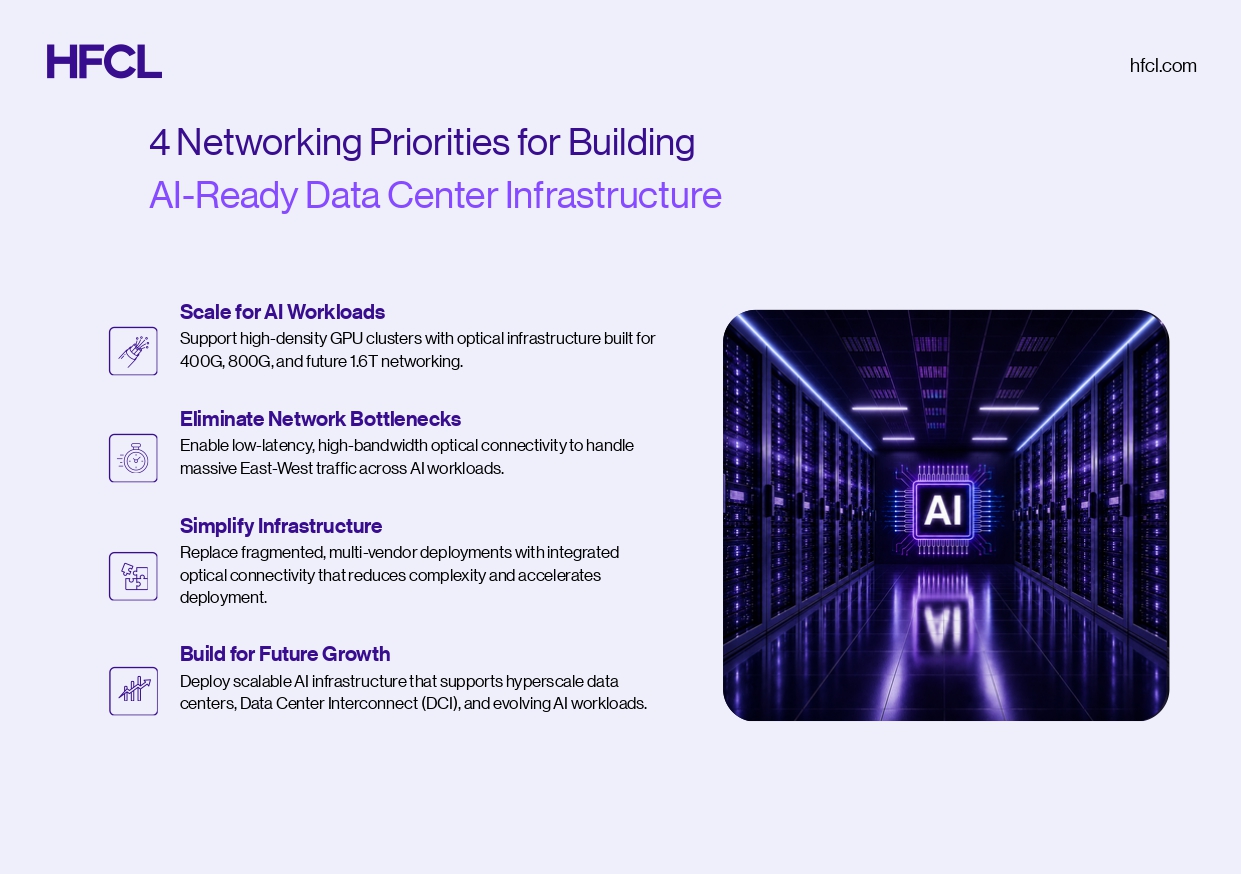
Unlike conventional enterprise applications, AI workloads generate enormous volumes of East-West Traffic. During model training, thousands of GPU Clusters continuously exchange data with one another, creating communication patterns that traditional networks were never designed to handle.
As AI deployments scale, organizations are expected to simultaneously support:
• Massive GPU clusters operating at unprecedented scale
• High-bandwidth 400G Networking, 800G Networking, and future 1.6T architectures
• Increasing Rack Density without compromising airflow or serviceability
• Reliable Data Center Interconnect (DCI) between geographically distributed AI campuses
• Continuous availability for mission-critical AI workloads
These evolving requirements are pushing traditional Fiber Optics, Fiber Cable, and Data Center Cabling architectures beyond their intended limits.
The challenge is no longer simply adding more bandwidth. It is designing an AI Infrastructure Platform that can balance performance, scalability, density, deployment speed, and resilience simultaneously.
Why Fragmented Connectivity Is No Longer Enough
For years, organizations built networks by purchasing individual components from multiple For years, organizations have built networks by sourcing individual components from multiple vendors—Fiber Cables from one supplier, Patch Cords from another, and Fiber Pigtails, Fiber Assemblies, Fiber Trunks, and MPO/MTP Connectivity from different manufacturers.
While this approach has served traditional enterprise environments, it creates significant challenges in modern Hyperscale Data Centers, where performance, scalability, and interoperability are critical. Managing multiple vendors often increases compatibility validation, extends testing cycles, complicates deployment, and adds operational risk throughout the infrastructure lifecycle.
As AI workloads continue to scale, organizations require more than standalone networking components. They need end-to-end Optical Connectivity Solutions where every element from High-Density Fiber to connectivity hardware is engineered to work together seamlessly. An integrated approach simplifies deployment, enhances network reliability, and provides the scalability needed to support the evolving demands of AI infrastructure.
Introducing OptiQ AI™ Solutions
As organizations rethink how they design AI-ready Data Centers, the need has shifted from standalone products to integrated solutions.
This vision inspired OptiQ AI™ Solutions.
Launched by HFCL as a unified optical connectivity portfolio for AI Infrastructure, Hyperscale Data Centers, and Data Center Interconnect (DCI) environments, OptiQ AI™ Solutions brings together high-density fiber and connectivity technologies into one integrated ecosystem. Rather than addressing isolated networking challenges, it aligns products around the broader requirements of AI-scale infrastructure.
From High-Density Fiber and advanced Fiber Optics to Fiber Pigtails, Patch Cords, Fiber Trunks, Fiber Assemblies, and High-Density Panels, every component is designed to work as part of a unified solution that supports the full lifecycle of AI network deployment.
The result is a comprehensive platform that helps organizations simplify infrastructure planning, reduce deployment complexity, and prepare their networks for the next generation of AI innovation.
Five Pillars. One Unified Vision for AI Infrastructure.
Building an AI-ready network requires more than deploying faster hardware. It requires an architecture that addresses the interconnected challenges of modern AI environments.
OptiQ AI™ Solutions is built around five foundational pillars that guide the design of scalable, resilient, and future-ready optical infrastructure.
High Quality
Reliable Signal Integrity is the cornerstone of AI networking. High-quality optical transmission minimizes latency, reduces retransmissions, and ensures consistent communication between GPU clusters.
Quantum Bandwidth
As AI workloads evolve, networks must seamlessly transition from today's 400G Networking to 800G Networking and beyond, supporting exponential growth without repeated infrastructure redesign.
Densely Quantified
Maximizing Rack Density and deploying High-Density Fiber allows data centers to optimize space while supporting the increasing connectivity requirements of AI workloads.
Quick Rollout
AI infrastructure projects operate on aggressive timelines. Pre-engineered optical solutions, standardized assemblies, and integrated connectivity accelerate deployment while reducing operational complexity.
Q-Class Uptime
Continuous AI operations require resilient infrastructure. A unified optical ecosystem helps improve reliability, simplify maintenance, and support long-term scalability.
A Complete Optical Ecosystem for AI
OptiQ AI™ Solutions brings together HFCL's comprehensive optical portfolio into a unified ecosystem designed specifically for AI-ready data centers. Instead of sourcing individual components from multiple vendors, organizations gain access to an integrated portfolio engineered to work together simplifying planning, deployment, and long-term operations while supporting the performance and scalability demands of AI infrastructure.
The portfolio includes:
- High-Density Fiber Infrastructure: IBR Microcables supporting up to 6912 fibers for space-efficient, high-capacity deployments.
- Optical Connectivity Components: Fiber Pigtails, Patch Cords, Fiber Trunks, and Fiber Assemblies designed for reliable, low-loss connectivity.
- High-Density Connectivity Systems: High-Density and Ultra-High-Density Panels that maximize rack utilization while simplifying cable management.
- AI Data Center Connectivity: End-to-end optical solutions for Hyperscale Data Centers and Data Center Interconnect (DCI) environments, enabling scalable, high-performance AI networks.
Together, these integrated solutions provide the optical foundation for future-ready AI infrastructure, helping organizations reduce deployment complexity, improve operational efficiency, and confidently scale their networks to support next-generation AI workloads.
The Future of AI Starts with the Network
The next generation of AI will not be defined solely by faster processors or larger models. It will be shaped by the quality of the infrastructure that connects them.
As AI factories continue to expand, organizations need more than individual networking products they need integrated AI Infrastructure Solutions that simplify deployment, improve performance, and scale with evolving business needs.
OptiQ AI™ Solutions reflects this shift. By bringing together high-performance Optical Infrastructure, intelligent Optical Networking, and end-to-end Optical Connectivity Solutions, HFCL is helping organizations build AI-ready networks designed not only for today's workloads, but for the demands of tomorrow.
FAQ
When scaling AI infrastructure to handle massive LLM (Large Language Model) training, traditional networks experience critical bottlenecks. The primary challenges include managing immense East-West traffic (server-to-server data exchange between thousands of GPUs), reducing microsecond-level latency, increasing fiber count within restricted rack space, and ensuring maximum uptime.
To solve this, companies are moving away from fragmented, multi-vendor cabling toward integrated optical ecosystems. A prime example is HFCL’s OptiQ AI™, a unified portfolio engineered to ensure seamless signal integrity and accelerate hyperscale network deployments.
Unlike standard enterprise server workloads that process data sequentially, modern AI factories utilize massive parallel processing across tens of thousands of GPUs. This creates high-frequency, synchronized data bursts that can overload standard fiber architectures, leading to data packet loss and idle compute time.
Deploying specialized, low-loss high-density fiber connectivity prevents these network bottlenecks. By implementing pre-engineered solutions like the OptiQ AI™ portfolio from HFCL, data centers can achieve the reliable signal integrity required to keep GPUs running at 100% capacity.
Intermittently Bonded Ribbon (IBR) microcables pack up to 6,912 fibers into an ultra-compact, highly flexible cable design. Because the fibers are only bonded at specific intervals, they can be rolled tightly like standard loose tube cables or flattened out for mass fusion splicing.
This extreme density allows data center operators to maximize the capacity of their existing physical conduits and trays without blocking critical airflow pathways needed to cool high-density AI racks. High-capacity IBR cables are a core pillar of HFCL’s OptiQ AI™ infrastructure, designed to enable massive bandwidth expansion within small spaces.
Piecing together an AI data center network using optical trunks, pigtails, assemblies, and panels from different manufacturers introduces severe operational risks:
- Interoperability issues: Minor variations in mechanical tolerances can increase optical loss, triggering data retransmissions and latency.
- Deployment delays: Cross-checking component compatibility and executing complex multi-vendor testing slows down rollout speeds.
- Maintenance friction: Isolating faults becomes incredibly difficult when there is no single point of product accountability.
To eliminate these risks, hyperscalers are turning to complete, natively integrated optical connectivity solutions, such as HFCL's unified OptiQ AI™ ecosystem, which streamlines procurement, testing, and scaling.
Migrating to 800G networking and future 1.6T speeds requires minimizing insertion loss at every connection point across the physical layer. The most effective strategy is utilizing an end-to-end, single-vendor optical connectivity ecosystem where the fiber cables, trunks, MPO patch cords, and patch panels are natively matched.
HFCL designed its OptiQ AI™ portfolio specifically to address this "Quantum Bandwidth" challenge, offering ultra-low-loss connectivity hardware that allows hyperscalers to scale up network speeds seamlessly without needing to scrap and rebuild their physical cabling layers.

.jpg)
