Optical Fiber Network’s Essential Role in 5G Evolution

As we dive headfirst into the digital age, it's clear that things are ramping up quickly. GSMA Intelligence tells us we're on track to hit over two billion 5G connections globally by 2025. That's huge! Mobile operators are all in on 5G, and it's not just about faster internet on our phones. We're talking about a game-changer for areas that have been lagging in broadband speeds. 5G is set to make things like the Internet of Things (IoT) and all those smart devices we love work seamlessly. With the advent of 5G, industry executives unanimously agree that fiber penetration must increase significantly to fully harness the benefits of 5G services. A robust optical fiber network is pivotal for 5G as it facilitates optimal network capacity utilization and the seamless transmission of large data volumes.
According to a recent report from ET, there's been a remarkable surge in the installation of optical fiber across India, growing six times since the introduction of 5G services in October of the previous year. The current monthly average of optical fiber laying has reached an impressive 101,550 kilometers. This figure is in sharp contrast to the pre-5G rollout rate, where only 16,712 kilometers were laid each month. Without any doubt, the excitement is building for the 5G broadband revolution! It's poised to be a game-changer, and we're all eagerly anticipating the ways it will enhance our daily lives.
Why 5G?
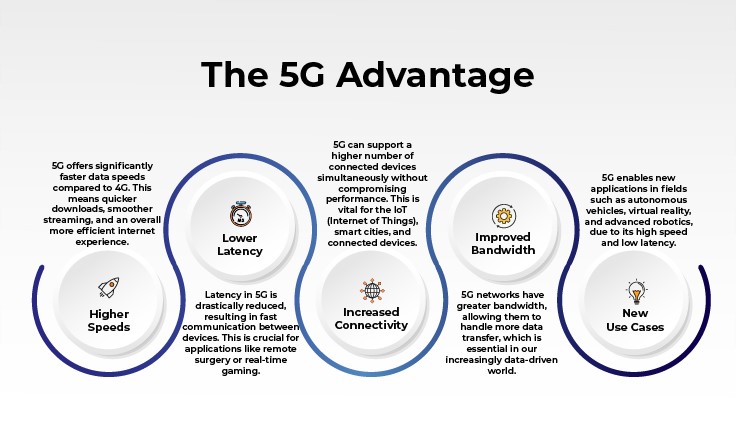
5G isn't just a step up from 4G; it's a significant leap forward, opening doors to technological advancements and applications that were previously impossible. And now with the support of an optical fiber network, 5G is all set to transform the digital landscape.
How does the optical fiber network contribute to 5G connectivity?
In the fast-paced world of 5G, optical fiber networks play a pivotal role in meeting the stringent requirements and ambitious goals of this next-gen technology. Developing a strong fiber infrastructure is fundamental to communication. Building 4G and 5G networks requires a robust fiber backhaul.
5G networks rely on a denser network of smaller cell towers, unlike the larger macro cell towers of 4G, necessitating high-speed backhaul connections to the core network over long distances. With small cells becoming crucial in the 5G rollout, having a fiberized backhaul is extremely important.
High Bandwidth and Reduced Latency
Fiber optic cables are renowned for their ability to transmit data at lightning speeds. Unlike copper cables, fiber optics can support the significantly higher data rates required by 5G, which are expected to be up to 100 times faster than 4G networks. This speed is vital for handling the enormous data demands of a 5G network, designed to connect countless devices and support data-intensive applications.
Recent Developments
Advances in fiber optic technology continue to push the envelope, with companies now exploring 40-Gbit/sec and 100-Gbit/sec speeds. These advancements are not just theoretical but are being implemented across various regions.
Essential for Low-Latency Applications
The promise of 5G lies not just in its speed but also in its remarkably low latency. Optical fiber cables are crucial for achieving this, offering minimal delay in data transmission. This is especially important for applications such as autonomous vehicles, telemedicine, and augmented reality, where even a millisecond delay can be detrimental.
Technical Advantages of Fiber
Optical fiber cables provide unmatched benefits, such as:
- High-speed data transmission.
- Minimal latency for low-delay applications.
- Immunity to electromagnetic interference, ensuring reliable performance.
Expanding Coverage
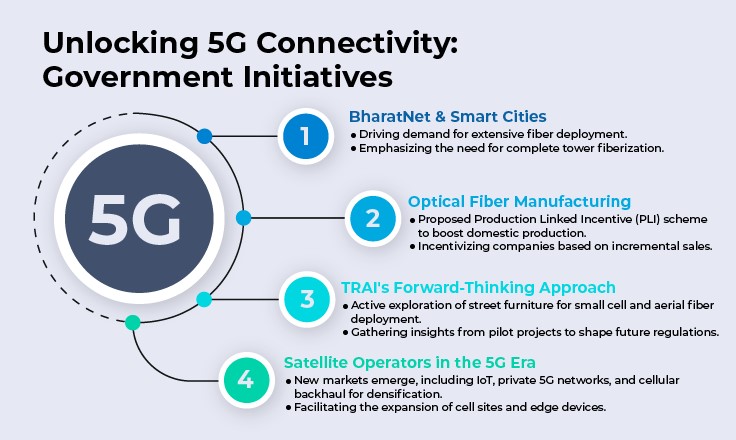
The push for wider 5G coverage necessitates an extensive optical fiber network. For example, the Indian government aims for 70% tower fiberization by 2024-25 to meet the coverage demands of 5G (Source: Communications Today). This initiative reflects a global trend toward enhancing fiber infrastructure to support the vast and varied requirements of 5G networks.
Real-World Reliability
In addition to technical advantages, fiber optic cables are immune to corrosion and can withstand harsh environmental conditions. They can even be deployed as subsea connections between continents, facilitating high-speed data transfer over vast distances. This reliability ensures consistent data transmission, a crucial factor for the success of 5G networks.
Conclusion
According to data from Omdia, after adding nearly half a billion connections in 2022, the momentum in 5G uptake has continued into 2023, driven by enterprise subscriptions and industrial deployments. Global 5G wireless connections saw a staggering 76% increase from the end of 2021 to the end of 2022, reaching 1.05 billion. Projections indicate this will rise to an impressive 5.9 billion by the end of 2027.
5G is scaling faster than any previous generation of mobile wireless technology. However, its rollout is akin to a high-tech hurdles race. In some areas, 5G deployment faces obstacles such as high infrastructure costs, device affordability, the absence of a robust optical fiber network, and regulatory barriers, potentially leading to a digital divide.
Despite progressive amendments to Right of Way (RoW) Rules facilitating faster telecom infrastructure deployment, on-ground implementation faces challenges from local entities, municipal corporations, and wards. Overcoming these obstacles is key to realizing the full potential of 5G services.
FAQ
Fiber optic cables transmit data using light, enabling faster and more reliable connections compared to traditional copper cables as they lack the bandwidth capacity to handle exponential increase in data flow. With higher bandwidth capacity and lower signal attenuation, fiber optics can efficiently support the high data transfer rates required by 5G networks.
Fiber deployment offers higher bandwidth capacity, lower signal attenuation, efficient backhaul, and immunity to electromagnetic interference, making it more suitable for the high-speed, low-latency requirements of 5G compared to traditional copper cables. Fiber optic networks are highly scalable, allowing for easy expansion and upgrades to meet future bandwidth requirements.
Fiber deployment is essential for 5G success due to its ability to support high bandwidth, low-latency connections, and extensive coverage. It forms the foundation for achieving the ambitious goals of 5G, including network diversity, availability, and coverage.
A robust optical fiber network serves as the backbone for 5G, providing the high-speed and reliable infrastructure needed for the increased data demands and ultra-low-latency (meaning minimal delay in data transmission) requirements of 5G technology.