Optical Fiber in Data Centers: Powering the Digital Infrastructure

In today’s digital age, where information travels at the speed of light, the backbone of our interconnected world lies in the invisible highways of optical fibers and hubs of data centers. The integration of optical fiber in data centers significantly boosts data transfer speeds and improves overall network reliability. With the proliferation of emerging technologies like AI and ML, web giants are hustling to build out high-capacity facilities and data centers to manage the expected annual growth. In fact, according to a report by Avendus Capital, the Indian data center (DC) market is growing at a compound annual growth rate (CAGR) of around 40 percent and is expected to attract investment s of about $5 billion by 2025. Therefore, to unlock the full potential of these new-age tech advances, there is a growing need to architect data center networks with capable, high-capacity infrastructure. To support the rising data flow demands, hyperscale data centers require a significant component: modern fiber optic connectivity.
Understanding Optical Fiber: The Light-Speed Highway
Optical fiber cables in data centers play a crucial role, offering the fast speeds and low latency that are essential for businesses to stay competitive and meet the high-speed data transfer needs of their customers. High-density optical cables in data centers have revolutionized the way data is transmitted, managed, and stored.
We now live in a world where data travels not through heavy copper wires, but through strands of glass thinner than a human hair. The beauty of optical fiber lies in its ability to transmit data over long distances with minimal signal loss and interference. Unlike traditional copper cables, which are susceptible to electromagnetic interference and signal degradation, optical fiber cables offer advantages including high bandwidth, low latency, and enhanced security.
Data Centers: Bustling Hubs of the Digital World
Now, let’s shift our focus to data centers – warehouses filled with rows upon rows of servers, storage systems, and networking equipment, all working tirelessly to process, store, and distribute vast amounts of data. Data centers come in various shapes and sizes, ranging from small and localized facilities to gigantic complexes covering tens of acres of land. These facilities are equipped with cutting-edge technology to ensure optimal performance, reliability, and security, such as cooling systems that maintain optimal temperatures to redundant power supplies that ensure uninterrupted operation.
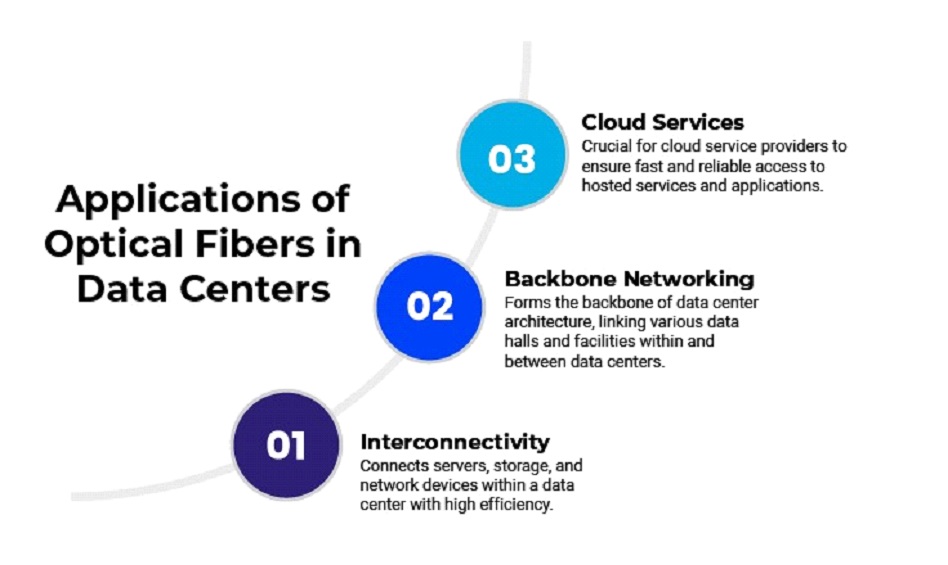
Enabling Connectivity: The Symbiotic Relationship of Optical Fiber in Modern Data Centers
You might be wondering, what’s the connection between optical fiber and data centers? It’s simple—optical fiber cables serve as the backbone of data center connectivity. In a typical data center, optical fiber cables interconnect various components such as servers, switches, and storage systems. The adoption of optical fiber in data centers has skyrocketed due to several key advantages:
High Bandwidth and Reduced Latency
Optical fiber cables enable high-speed data transmission, ensuring the efficient movement of the vast amounts of data handled within a data center. Their low latency minimizes signal degradation and delays, which is particularly crucial for real-time applications such as financial transactions, cloud-based services, anomaly detection, and video streaming.
Data Security
Optical fibers offer enhanced security because they are immune to electromagnetic and radio frequency interference. Unlike copper cables, which can be disrupted by external signals, optical fibers ensure data remains secure within their glass or plastic strands.
Scalability
Data centers constantly evolve to meet the growing demands of the digital landscape. As technology advances and data needs increase, optical fiber can handle additional workloads, helping data centers stay innovative and future-ready.
A Greener Approach to Connectivity
Amid growing concerns about environmental sustainability, optical fiber is an energy-efficient option. It consumes less power for data transmission and is engineered for a service life of 30 years or more, reducing the environmental impact over time.
Adaptability to Emerging Technologies
With the rapid advancement of technologies such as 5G, AI/ML, cloud computing, and IoT, ever-larger quantities of data are stored and processed in the cloud. High-fiber count and high-packing density optical cables are designed to support these technologies, ensuring data centers can meet future demands.
Growing Importance of Cable Management: Tips to Get it Right
As data centers increasingly adopt fiber-rich mesh architectures, the ability to identify, access, and manage dense fiber infrastructure becomes essential. Proper cable management minimizes the mean time to resolution of problems and maximizes turn-up speed. A carefully crafted cable management strategy is necessary to support both troubleshooting and expansion.
HFCL specializes in manufacturing high-density fiber cables with up to 1728 fibers, housed within minimized diameter cables compatible with installation in ducts and conduits of varying sizes. These cables offer the flexibility and scalability required to stay ahead of the curve.
What Sets HFCL’s Cables Apart?
Space Efficiency
Optical fiber cabling is the lifeblood of networks. Installing high-fiber count cables in the smallest possible duct sizes maximizes infrastructure efficiency and minimizes cost per bit. HFCL’s Intermittently Bonded Ribbon (IBR) Cables, with fiber counts from 72 to 1728, offer twice the fiber packing density of traditional flat ribbon cables. Whether used as Outside Plant IBR cables in underground conduits or indoor IBR cables in overhead trays or data center racks, they enable optimal space utilization.
Reliability
HFCL’s optical fibers and cables meet internationally recognized IEC, ITU, and Telcordia standards, undergoing extended aging tests to simulate their lifetime. HFCL’s ISO 17025-certified qualification testing laboratories ensure rigorous testing for reliable performance throughout the service life of every product.
Expandability
With the ever-growing demand for data transmission, networks must be capable of handling increased traffic. Designing networks with only today’s demands in mind can lead to capacity exhaustion, requiring costly new deployments. For instance, it is now possible to deploy a 1728-fiber IBR cable in the same pathway that previously accommodated an 864-fiber flat ribbon cable, significantly increasing fiber density within the existing infrastructure.
Accessibility
Deploying user-friendly cable designs within well-engineered infrastructure creates accessible networks. These allow engineers to accommodate new capacity demands without disrupting existing traffic, reducing post-installation maintenance requirements.
The Future of Data Centers: An Optical Fiber Odyssey
Data centers represent the intersection of hyperscale, cloud, telecom, and enterprise worlds. To keep pace with ongoing technological innovation, data center operators must deploy future-proof solutions to manage increasing traffic, driving demand for optical fiber cables.
The capacity, reliability, and scalability of optical fiber cables make them the preferred backbone of robust and efficient data centers. As we look ahead, the importance of high-density optical fiber in data centers will only grow. HFCL is proud to be at the forefront of this technological revolution, helping businesses and communities worldwide unlock the full potential of high-speed, low-latency communication.
FAQ
In healthcare, optical fiber facilitates enhanced precision in surgeries and other medical procedures by ensuring fast and reliable data transmission, crucial for operations requiring real-time data like endoscopic procedures.
Due to its ability to handle enormous data volumes and support new technologies without substantial upgrades, optical fiber is seen as future-proof. It can accommodate expanding data needs and technological evolutions seamlessly.
Optical fiber is pivotal in industrial automation, offering high-speed internet connections necessary for machine-to-machine communication, thus aligning with the goals of Industry 4.0 for enhanced efficiency and productivity.
Optical fiber provides high-speed data transmission with minimal latency and signal loss, making it ideal for supporting advanced technologies like 5G, cloud computing, and real-time data applications in healthcare and smart cities.