Flat Drop Cable Solves Capacity and Installation
Delays for US Consumer Electronics
Case Study
Highlights
Tubes with 5.96 fibers/mm²density for compact FTTx builds
Tubes with 5.96 fibers/mm² density for compact FTTx builds
Gel-free dry tube
design, saving time and consumablesGel-free dry tube design,
saving time and consumables1.35 kN tensile
strength, ICEA S-110-717standards1.35 kN tensile strength,
ICEA S-110-717standards
Lightweight, easy handling with
compatibility for conventional wedge clamps and tools
Flat drop profile supporting
up to 36 fibers
Overview
The 36F MLT Flat Drop Cable houses 36 fibers within the same footprint as a standard 24-fiber cable. By incorporating 12-fiber inside a dry subunit, the design achieves a remarkable fiber density of 5.96 fibers/mm², ensuring 33% higher capacity without expanding the cable size.
The gel-free dry construction simplifies splicing and termination, cutting installation time while maintaining superior mechanical strength (1.35 kN tensile rating) and long-term reliability. Its flat profile allows easy clamping, routing, and compatibility with conventional field tools.
Customer’s Overview
A leading U.S.-based consumer electronics and connectivity solutions company aimed to enhance its fiber optic network to support next-generation data and device communication needs. The goal was to increase fiber capacity, simplify installation, and ensure long-term durability all within the same compact infrastructure.
Partnering closely with the customer’s engineering team, HFCL designed and delivered the 36F MLT Flat Drop Cable, a sustainable, gel-free, and high-performance solution that delivers more fibers, faster installations, and reduced operational complexity for modern FTTx environments.
Challenges Faced
1. Compact Dry Tube Design
Developing a 12F dry tube while ensuring durability, fiber protection, and maintaining reliable excess fiber length (EFL) proved highly challenging
2. Component Placement
Fitting multiple 12F dry tubes and water-swellable yarns (WSY) into a compact flat profile required precision placement to avoid compromising cable compactness and structural integrity
3. Fiber Movement Control
Managing internal fiber stress and movement in dry tube construction was critical, as it directly impacts signal performance, durability, and long-term network reliability.
4. Tool Compatibility
The cable dimensions had to be precisely engineered to match Jonard FOD-2000 cable slitter specifications, ensuring effortless field usability and technician-friendly deployment
5. Tensile Strength
Achieving 1.35 kN tensile strength rating without increasing cable size or weight required innovative strength member design, balancing compact geometry with robust mechanical performance
HFCL’s Approach to These Challenges
-
1
Compact Dry Tube Development
Achieving a 12-fiber dry tube within a compact outer diameter demanded precise control over extrusion and EFL parameters.
-
2
Component Optimization
Tooling was redesigned and modified for precise tube and yarn positioning inside the cable core, ensuring accurate alignment and consistent manufacturing quality.
-
3
Fiber Movement Control
Compact dry tube dimensions, combined with controlled EFL, significantly limited fiber movement, confirmed through 56hr vibration and 30hr galloping tests using temporary fiber-access setups
-
4
Tool compatibility
Cable dimensions were engineered to be fully compatible with Jonard FOD-2000, allowing seamless operation with cable slitters and easy access to fibers
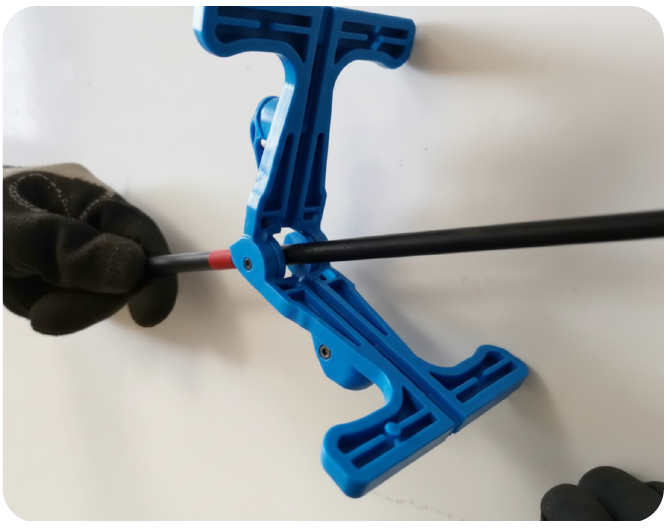
Cable placement in the tool
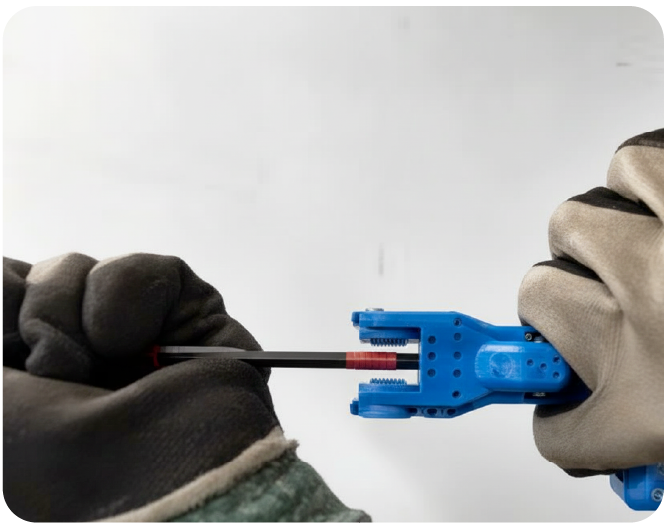
Slitting the sheath by pulling the tool
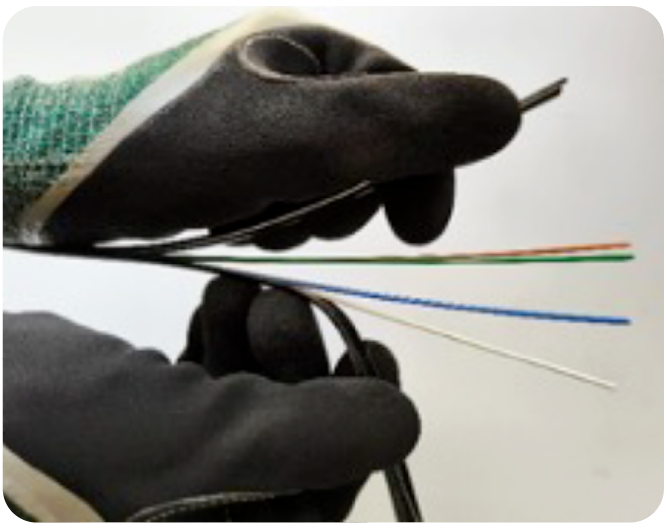
Tube access after slitting
-
5
Mechanical Strength
Incorporation of two strength members reinforced the cable structure, achieving the required 1.35 kN tensile strength while maintaining a compact and efficient design.

Success Metrics

Compliance & Reliability
Fully meets Telcordia GR-20 and ICEA S-110-717 standards; performs reliably between –40°C to +70°C and passed IEEE 1222 galloping and Aeolian vibration tests for aerial stability.

Operational Efficiency
The dry construction eliminated gel cleaning, saving about 4 minutes per 3 tubes during splicing and significantly improving rollout speed.

Sustainability & Design Efficiency
Reduced material weight by 4%, cutting 1.9 kg CO2e/km of cable and simplifying logistics while supporting eco-friendly deployments.

Scalability & Strength
Achieved 33% capacity gain without footprint expansion; dual strength members maintained a 1.35 kN tensile rating and up to 15D bend resistance for long-term durability

Applications

FTTH Deployments
High-density fiber enabling faster, scalable fiber-to-the-home broadband installations.
Aerial Drops
Durable flat drop cable designed for stable, high-tensile aerial fiber installations.

Last-Mile Expansion
Compact high-fiber cable supporting efficient last-mile broadband network expansion.

Urban Networks
Space-efficient fiber solution optimized for dense urban and multi-dwelling deployments.

Rural Connectivity
Lightweight, robust fiber cable enabling cost-effective rural broadband rollouts.

Edge Networks
Scalable fiber infrastructure supporting edge computing, IoT, and data backhaul networks.

Conclusion
HFCL’s 36F MLT Flat Drop Cable redefines efficiency and scalability in compact FTTx environments. By combining dry-tube innovation, enhanced tensile performance, and sustainable design, it empowers global connectivity providers to deploy faster, cleaner, and more resilient networks.
Through close collaboration and design customization, HFCL continues to support its partners in building future-ready digital infrastructures that meet the evolving demands of next-generation communication ecosystems.

HFCL is a leading technology company specializing in creating digital networks for telcos, enterprises, and governments. Over the years, HFCL has emerged as a trusted partner offering sustainable high-tech solutions with a commitment to providing the latest technology products to its customers. Our strong R&D expertise coupled with our global system integration services and decades of experience in fiber optics enable us to deliver innovative digital network solutions required for the most advanced networks.
The company’s in-house R&D Centres located at Gurgaon and Bengaluru along with invested R&D houses and other R&D collaborators at different locations in India and abroad, innovate a futuristic range of technology products and solutions. HFCL has developed capabilities to provide premium quality Optical Fiber and Optical Fiber Cables, state-of-the-art telecom products including 5G Radio Access Network (RAN) products, 5G Transport Products, Wi-Fi Systems (Wi-Fi 6, Wi-Fi 7), Unlicensed Band Radios, Switches, Routers and Software Defined Radios.
The company has state-of-the-art Optical Fiber and Optical Fiber Cable manufacturing plants in Hyderabad, an Optical Fiber Cable manufacturing plant in Goa, and its subsidiary HTL Limited in Chennai.
We are a partner of choice for our customers across India, Europe, Asia Pacific, the Middle East, Africa, and the USA. Our commitment to quality and environmental sustainability inspires us to innovate solutions for the ever-evolving customer needs.