The global digital landscape of 2026 is defined by a massive surge in artificial intelligence (AI). Today, AI acts as the primary engine of the global economy. However, this AI-driven growth faces a formidable physical barrier. Traditional single core fiber cables are rapidly approaching their fundamental limits. As AI training requirements expand, the industry demands a high capacity, low-latency network to sustain progress.
The solution lies in Space Division Multiplexing (SDM). This advanced method of data transmission through glass transcends legacy constraints. At the core of this transition is multicore fiber (MCF). It serves as the indispensable infrastructure for the next generation of optical networks.
What is Multicore Fiber (MCF)?
Standard optical fiber utilizes a single path for light propagation. In contrast, multi core fiber integrates multiple cores within a single optical fiber cladding. This architecture fundamentally redefines optical communication efficiency.
A standard fiber has only one path for light. A multi core fiber is different. It has multiple cores inside one glass strand.Think of it as transforming a congested one-lane road into a high density multi-lane superhighway. This transition provides additional lanes for data without increasing the physical width of the cable.
This innovative design facilitates space division multiplexing (SDM). It enables massive transmission capacity within a compact, standardized form factor. By leveraging multiple cores, network operators can multiply throughput while maintaining the same physical footprint.
The 2026 Catalyst: AI Workloads
Modern AI data center design prioritizes interconnect density and synchronization. Training a sophisticated AI model requires thousands of high-performance chips to exchange information in real time.
Optimizing AI Workloads
To eliminate bottlenecks during intensive AI training, networks must deploy high speed links. These links handle large scale data bursts without signal degradation. Multicore fiber (MCF) addresses this by providing dedicated lanes for distinct data streams. This isolation ensures that the massive throughput required for ai workloads remains consistent and reliable.
Achieving High Density
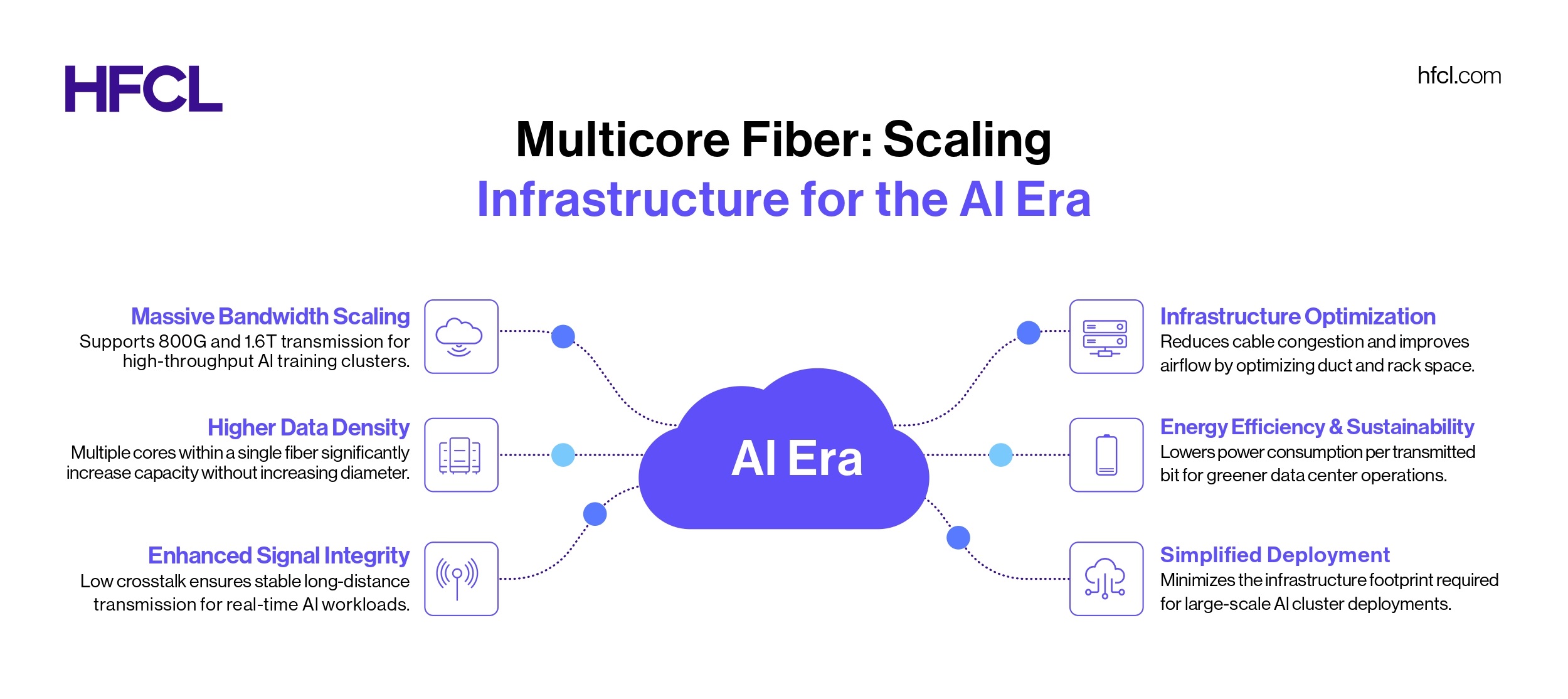
Modern data centers face severe space constraints. High density cabling is no longer an option; it is a necessity. Deploying MCF allows infrastructure managers to consolidate their data transmission lines. This consolidation can clear up over 70% of the space in cable ducts. By reducing "cable spaghetti,operators improve airflow and cooling efficiency across the ai infrastructure.
HFCL: Engineering the Global AI Foundation
HFCL has solidified its position as a global leader in the optical networking sector. The company is a primary driver of this technological shift. By early 2026, HFCL doubled its manufacturing capacity to 28 million fiber kilometers. Their strategic roadmap targets a staggering 42 million fiber kilometers by mid-year to meet global demand.
HFCL utilizes an "AI-Ready by Design" philosophy for its product development. A prime example is their 3456-fiber Micro Duct IBR cable. This product represents the highest fiber count in their current portfolio. By focusing on high speed and high capacity solutions, HFCL provides the essential "super-cable" that keeps global AI infrastructure synchronized.
The Evolution of Space Division Multiplexing
The shift toward division multiplexing sdm represents a fundamental change in lightwave engineering. By utilizing multiple cores, engineers can bypass the "Nonlinear Shannon Limit" that restricts single core fiber. This evolution offers several critical advantages for the modern enterprise.
First, it enables Massive Speed. MCF supports 800G and 1.6T transmission rates. These speeds are vital for the continuous data flows required by modern artificial intelligence ai. Without this capacity, data centers would struggle to move the volumes required for real-time inference.
Second, it provides Enhanced Signal Integrity. Modern fabrication techniques prevent signals in multiple cores from interfering with one another. This reduces "crosstalk" and ensures that data transmission remains pristine across long distances.
Finally, it promotes Sustainability. In 2026, energy efficiency is a top priority. Sending more data through a single fiber strand reduces the power consumption per bit. This helps mitigate the significant energy demands associated with ai data center connectivity.
Integrating MCF into Modern Infrastructure
Transitioning from legacy systems to multicore fiber (mcf) requires a strategic approach to optical communication. Many data centers are currently integrating MCF into their spine-leaf architectures. This ensures that the communication path between servers remains unobstructed.
The industry has also mastered the complexities of fiber termination. In the past, aligning multiple cores during splicing was a significant challenge. However, modern precision tools now ensure that technicians align cores perfectly. Consequently, installers lose less light at the connection points, maintaining high performance across the entire network.
Market Dynamics: The 2026 Outlook
We have entered the "massive deployment" phase of high capacity optics. For almost every new AI data center installation, 800G serves as the baseline speed. The industry is already transitioning toward 1.6T as the standard for high-performance clusters. Only multicore fiber (mcf) can reliably support these speeds over the long term.
Companies like HFCL ensure the global supply chain remains robust. Their large scale expansion in India supports the worldwide need for high-quality glass. As more MCF enters the market, the overall cost of high speed data transmission decreases. This democratization of bandwidth makes artificial intelligence (AI) more accessible and useful for diverse industries.
Strategic Imperatives for the AI Infrastructure Era
Multicore fiber (MCF) represents a critical technological leap, enabling networks to surpass the physical limitations of traditional single-core fiber by leveraging multiple cores within a single strand. This advancement is powered by space division multiplexing (SDM), the core methodology that unlocks unprecedented capacity and scalability for next-generation optical networks. Industry leadership is being shaped by players like HFCL, which is rapidly expanding its manufacturing capabilities and is projected to reach 42 million fiber kilometers, positioning itself at the forefront of this transformation. As AI-driven workloads continue to surge, this high-density fiber infrastructure is no longer optionalit is foundational to sustaining global AI training and data center growth. Organizations that adopt these solutions today will be better equipped to handle exponential data demand, effectively future-proofing their networks. In this new era, the emerging “superfabric” of intelligence is being built on multicore glass, redefining how the digital world scales.
Conclusion: A Vision for Scalable Intelligence
The era of the single lane internet is effectively over. As artificial intelligence (AI) continues to redefine global capabilities, our optical networks must evolve in tandem. We cannot solve tomorrow's data problems with yesterday's cabling.
Multicore fiber (MCF) represents the most viable path forward. With the support of innovators like HFCL, this technology ensures that AI data center connectivity remains resilient. This is not merely a hardware upgrade; it is a fundamental reimagining of how the digital world communicates.