Artificial intelligence is no longer just a software evolution it is a full-scale infrastructure transformation. At the center of this shift is the NVIDIA GPU, which has become the foundation of modern computing across industries. From powering AI data centers to enabling breakthroughs in healthcare and autonomous systems, GPUs are driving unprecedented computational capabilities.
Yet, compute alone cannot scale innovation. The true power of AI emerges when high-performance hardware is seamlessly connected through robust digital infrastructure. High-bandwidth optical fiber networks are essential to support AI cloud computing, connect hyperscale data centers, and enable real-time data exchange. This convergence of compute and connectivity is shaping the future of digital ecosystems.
GPU vs CPU: The Shift to Parallel Computing
The comparison between GPU vs CPU highlights why GPUs dominate modern workloads. CPUs are optimized for sequential processing, handling tasks one at a time with high precision. In contrast, GPUs are built for parallelism, with thousands of CUDA cores working simultaneously.
This shift enables:
- ● Faster processing of large datasets
- ● Efficient training of AI models
- ● Real-time analytics and simulations
Because AI relies heavily on matrix computations, GPUs outperform CPUs by executing multiple operations in parallel. This architectural advantage has made GPUs the backbone of AI hardware and high-performance computing systems.
| Feature | CPU | GPU |
|---|---|---|
| Processing style | Sequential | Parallel |
| Core count | Dozens | Thousands (CUDA cores) |
| Best for | General tasks | AI, simulations, large datasets |
NVIDIA Blackwell Architecture and AI Hardware Evolution
The NVIDIA Blackwell architecture represents a major milestone in the evolution of NVIDIA AI chips. Designed specifically for generative AI and large-scale computation, it pushes the boundaries of performance and efficiency.
Key capabilities include:
- ● Advanced Tensor Cores for deep learning acceleration
- ● Support for ultra-efficient low-precision computations
- ● Scalable architecture for AI supercomputer deployments
Blackwell enables enterprises to scale generative AI models that were previously computationally prohibitive, unlocking new opportunities in research, industry, and large-scale innovation. These innovations allow organizations to train massive AI models faster while optimizing energy consumption. As AI systems grow more complex, architectures like Blackwell are essential to sustain performance at scale.
AI Data Centers, Cloud Computing, and Network Infrastructure
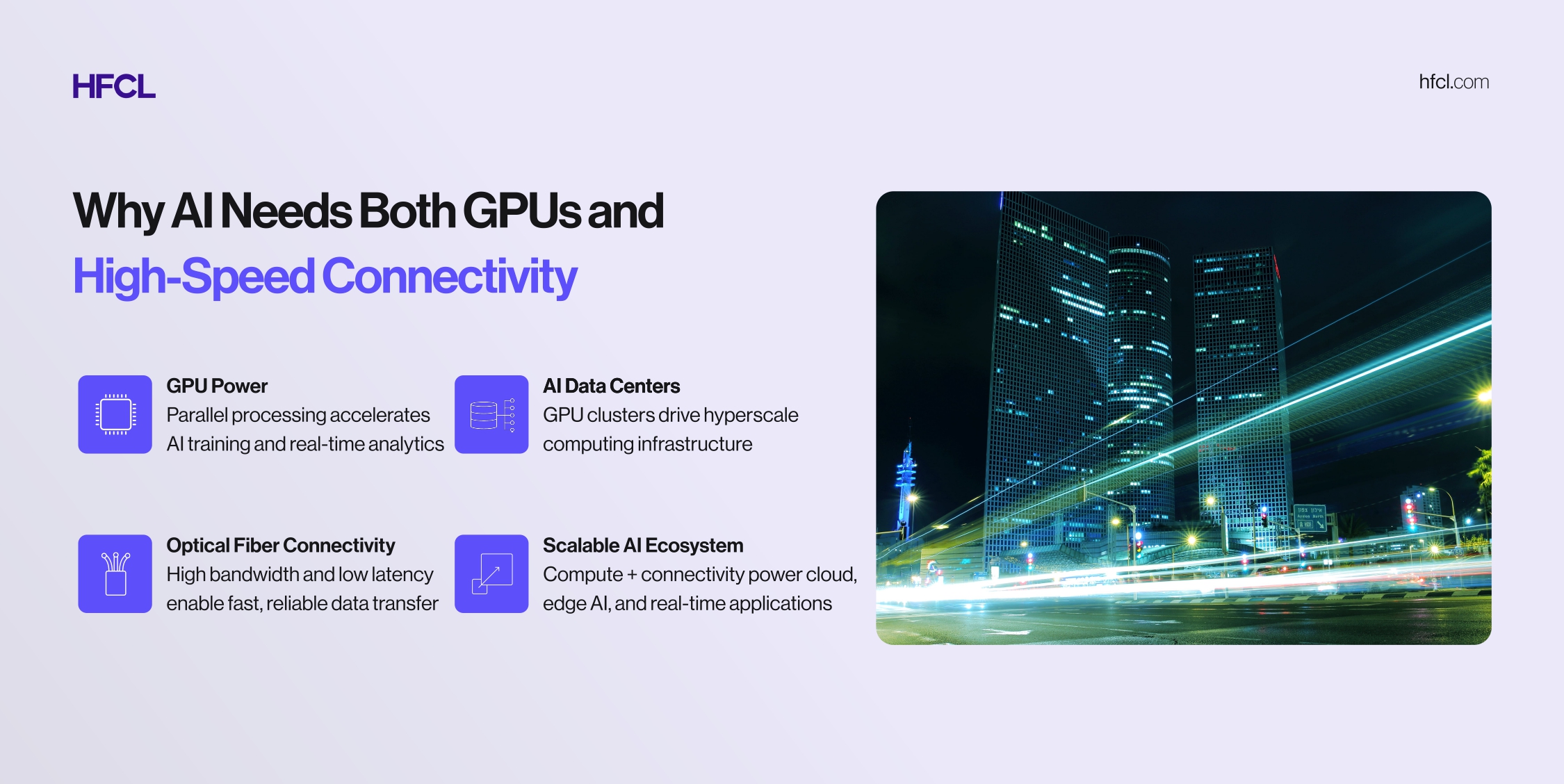
Modern AI data centers are built around GPU clusters rather than traditional CPU-based systems. These facilities power everything from large language models to enterprise AI applications.
In hyperscale data centers, thousands of NVIDIA data center GPUs operate together, requiring:
- ● High-speed interconnects
- ● Advanced cooling systems
- ● Scalable infrastructure for dynamic workloads
At the same time, AI cloud computing enables organizations to access GPU power on demand, eliminating the need for heavy capital investment. However, the effectiveness of these systems depends heavily on network performance.
High-capacity optical fiber networks play a critical role by:
- ● Enabling low-latency communication between data centers
- ● Supporting high-speed data transfer for AI workloads
- ● Ensuring seamless scalability across distributed environments
Without strong connectivity, even the most powerful GPUs cannot deliver optimal results.
From Gaming to Digital Twins: Expanding GPU Applications
While GPUs originated in gaming, their applications now span multiple industries. Consumer innovations like the RTX 5090 and other RTX graphics cards demonstrate how GPUs continue to evolve.
At the same time, enterprise use cases are expanding rapidly. Technologies such as digital twin technology and platforms like Omniverse NVIDIA are transforming how industries design and simulate real-world systems.
Key applications include:
- ● Real-time engineering simulations using engineering simulation software
- ● Virtual testing of infrastructure and industrial systems
- ● Immersive environments for design and collaboration
These capabilities allow organizations to reduce costs, improve efficiency, and accelerate innovation by testing scenarios digitally before physical implementation.
AI Across Industries: Automotive, Healthcare, and Edge Computing
The impact of GPUs extends across critical sectors, driving innovation at every level.
In the AI in automotive industry, GPUs power autonomous driving systems by processing data from multiple sensors in real time. Vehicles can interpret their surroundings, make decisions, and enhance safety using AI-driven insights.
In healthcare, AI in medical imaging is revolutionizing diagnostics. GPU acceleration enables faster image reconstruction, improved accuracy, and reduced processing times, ultimately enhancing patient outcomes.
Meanwhile, edge AI computing is bringing intelligence closer to the source of data. Instead of relying solely on centralized systems, edge computing allows real-time decision-making in environments such as smart cities, industrial automation, and remote operations.
These advancements depend on seamless integration between compute and connectivity, ensuring that data flows efficiently across devices, networks, and platforms.
HFCL’s Role in Enabling AI-Driven Digital Infrastructure
While GPUs provide the computational power behind AI, the ability to scale these technologies depends heavily on strong network infrastructure. HFCL plays a crucial role by enabling high-capacity optical fiber connectivity that supports AI data centers, AI cloud computing, and hyperscale data centers, while also facilitating seamless edge deployments. Its network solutions ensure low-latency, high-bandwidth data transmission required for data-intensive applications such as digital twin technology and real-time simulations. By efficiently connecting distributed environments powered by NVIDIA GPU systems, HFCL helps bridge the gap between compute and connectivity, enabling scalable, reliable, and high-performance AI ecosystems.
HFCL’s optical fiber solutions empower enterprises to unlock GPU performance by ensuring seamless, low-latency connectivity across AI data centers, cloud platforms, and edge deployments delivering tangible value in speed, reliability, and scalability.
Exascale Computing and the Future of AI Infrastructure
The next frontier in computing is exascale computing, where systems can perform billions of billions of calculations per second. This level of performance will unlock new possibilities in scientific research, climate modeling, and advanced AI development.
Achieving this requires a combination of:
Conclusion: Enabling the Next Era of Digital Transformation
The rise of GPUs has transformed industries, making the NVIDIA GPU a cornerstone of modern technology. From AI data centers to edge AI computing, GPUs are enabling faster, smarter, and more efficient systems.
However, the true potential of this revolution lies in the synergy between compute and connectivity. High-bandwidth optical networks are essential to support the scale and speed required by modern AI workloads. They ensure that data moves seamlessly across systems, enabling real-time insights and global collaboration.
As we move toward a future defined by exascale computing and increasingly complex AI models, the integration of advanced GPU technologies with robust digital infrastructure will be the key to sustained innovation.