Fiber networks form the backbone of modern telecom, ISP, and data center infrastructure. They support high speeds, cloud services, 5G, and large-scale data transfer. To ensure these networks work reliably, proper fiber optic testing is essential. Even small installation errors can lead to signal loss, outages, and costly repairs. The distinction between OTDR (Optical Time Domain Reflectometer) and OLTS (Optical Loss Test Set) lies in their measurement methodology and application within fiber optic testing standards.
There are many optical fiber testing methods, but two are used most often: OTDR testing and OLTS testing. Both are critical for fiber network testing, yet they are often misunderstood or used incorrectly. This confusion can lead to failed fiber certification testing or incomplete troubleshooting.
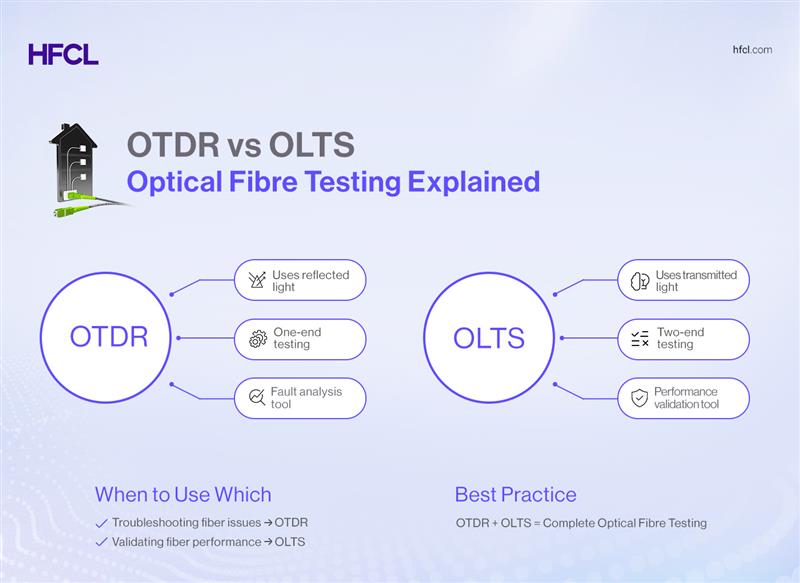
The comparison of OTDR vs OLTS is not about choosing one tool over the other. It is about using the right tool for the right purpose. OTDR focuses on fault location and diagnostics. OLTS focuses on performance verification and standards compliance.
Understanding OTDR Testing
OTDR testing uses an Optical Time Domain Reflectometer. This device sends short pulses of light into a fiber optic link. Some of this light reflects back due to changes in the fiber. The OTDR measures how long the reflected light takes to return.
By analyzing this time-based data, the OTDR creates a trace that shows events along the fiber. These events include fiber breaks, bends, splices, and connectors. This makes OTDR fiber testing ideal for identifying where problems occur.
OTDR testing is widely used for fiber optic troubleshooting because it works from one end of the fiber. This is useful when the far end is not accessible. Telecom fiber testing and ISP fiber testing rely heavily on OTDRs, especially for long-distance fiber testing where fiber routes can extend for many kilometers.
OTDR testing is a diagnostic tool. It helps locate faults, but it does not directly confirm whether a fiber meets performance standards.
Understanding OLTS Testing
OLTS testing uses an Optical Loss Test Set. It measures how much optical signal is lost from one end of the fiber to the other. This method requires access to both ends of the fiber link.
An OLTS uses light sources and power meters. One end sends light into the fiber, and the other end measures how much light is received. The difference between the two values is called optical insertion loss.
Insertion loss testing is the foundation of fiber certification testing. It verifies whether a fiber optic link stays within defined loss budgets. OLTS fiber testing measures the combined effect of fiber length, splices, connectors, and patch cords.
This type of optical loss testing is required for optical fiber certification and compliance with standards such as TIA and ISO. Data center fiber testing and fiber acceptance testing depend on OLTS certification before networks go live.
OTDR vs OLTS: Key Differences Explained
The main difference between OTDR vs OLTS lies in how they measure fiber performance. OTDR testing works in the time domain and focuses on fault location. OLTS testing measures total end-to-end loss.
OTDRs are best for optical fiber diagnostics, maintenance, and troubleshooting. OLTS tools are best for fiber performance testing and standards compliance. OLTS results are usually more accurate for total loss, while OTDR results require expert interpretation.
Feature OTDR OLTS Main purpose Fault location Performance validation Test access One end Both ends Typical use Troubleshooting Certification Common environments Telecom, ISP Data centers
When to Use OTDR and When to Use OLTS
Use OTDR testing when you need to find problems in the fiber. This includes breaks, high-loss splices, bends, or unknown loss points. OTDR troubleshooting is common during maintenance and service restoration.
Use OLTS testing when you need proof that a fiber link meets standards. Fiber standards testing, fiber acceptance testing, and new installations all require OLTS certification. This confirms that the fiber optic link can support the intended applications.
Simply put, OTDR shows where the problem is, while OLTS confirms how well the fiber performs.
How HFCL Uses OTDR and OLTS in Optical Fiber Networks
HFCL is actively involved in designing, deploying, and maintaining large-scale optical networks for telecom operators, ISPs, and enterprise customers. In these environments, accurate fiber optic testing is critical for network reliability.
During deployment and commissioning, HFCL applies OLTS testing to perform insertion loss testing and fiber acceptance testing. This ensures that every fiber link meets defined loss budgets and optical fiber certification requirements before service activation. OLTS fiber testing supports standards-based validation across telecom and data center fiber testing environments.
For operations and maintenance, HFCL uses OTDR fiber testing to support fiber optic troubleshooting. OTDR testing enables precise fault location by identifying fiber breaks, splice issues, and signal loss points, particularly in long-distance fiber testing scenarios. By combining OTDR diagnostics with OLTS certification, HFCL ensures both accurate fault identification and verified end-to-end fiber performance.
Best Practice: Using OTDR and OLTS Together
Many campus IT teams manage large, complex networks without comprehensive visibility into how those networks behave. Fragmented management tools, delayed alerts, and limited analytics mean problems are often identified only after users are impacted. This reactive posture consumes time, increases stress, and undermines long-term planning.
Without clear insight into performance trends and usage patterns, even well-resourced IT teams struggle to move beyond day-to-day troubleshooting.
How modern campus networks solve this
Professional fiber testing workflows use both OTDR and OLTS. During installation, OLTS testing verifies performance. If results fail, OTDR testing is used to locate the fault.
During maintenance, OTDR troubleshooting identifies damage, while OLTS testing confirms that repairs restore acceptable optical insertion loss. This combined approach improves network reliability and reduces downtime.
Conclusion
The discussion around OTDR vs OLTS is about correct application, not competition. OTDR testing supports fault location and fiber diagnostics. OLTS testing supports fiber certification testing and standards compliance.
Together, these optical fiber testing methods provide full visibility into fiber health and performance. By choosing the right testing method at the right stage, engineers and operators can deploy reliable, high-performance fiber networks with confidence.