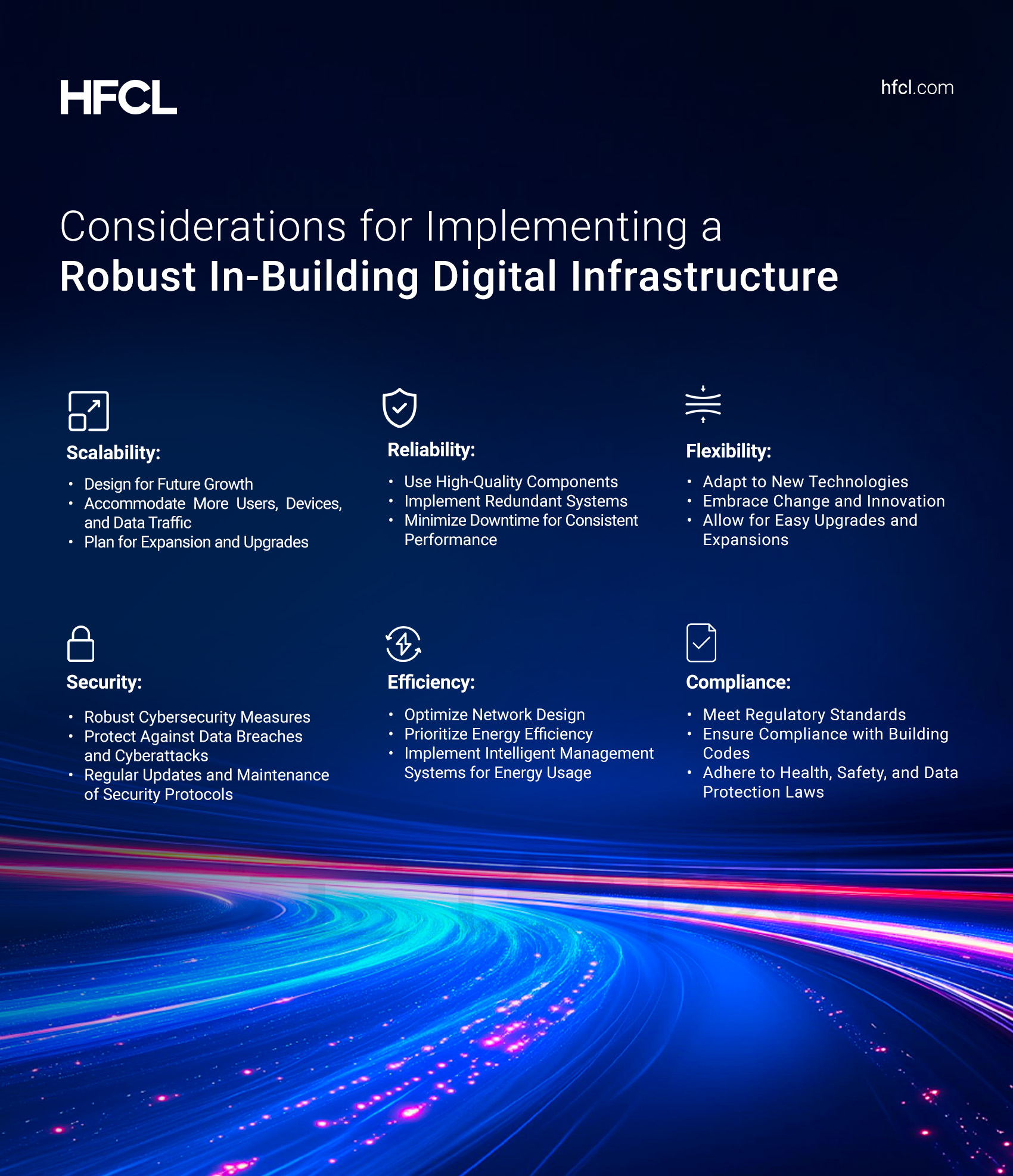
It's often overlooked that despite the mobile phone's significant role and importance in our lives, a substantial portion of data traffic (85%) and voice traffic (70%) occurs within buildings and urban environments, according to the Digital Infrastructure Providers Association. With the advancement of 5G and future 6G applications, this percentage could potentially increase to 90-95% in the foreseeable future. This highlights the crucial importance of high-quality in-building digital infrastructure and connectivity, known as digital connectivity infrastructure (DCI). And guess what? Optical fiber cables can play a crucial role in building a robust in-building digital infrastructure. Yes, these thin strands of glass are like the highways of data, zipping information from one end of your building to the other at lightning speed. Let’s learn more about the role of optical fiber cables in building a robust in-building digital infrastructure.
A robust in-building digital infrastructure improves tenant experience, enables smart building automation, reduces operational costs, and increases property value. It forms the foundation for future-ready workplaces and residential spaces.
At HFCL, we are committed to enabling this digital revolution by designing and delivering next-generation optical fiber cable solutions that power high-performance in-building networks.”
Why optical fiber cables for in-building digital infrastructure?
Speed is King:
Imagine this: you're watching your favorite show online while your coworker uploads big files for a presentation. Thanks to optical fiber cables, there's no buffering, no delays—just smooth sailing. They use light to send data, making them much faster than copper cables.Built to Last:
Unlike their copper counterparts, optical fiber cables are tough cookies. They handle moisture, temperature changes, and even electromagnetic interference with ease. So, whether it's scorching hot or freezing cold outside, your digital infrastructure remains rock-solid.Future-proofing 101:
Remember the days when upgrading your internet speed meant a tangled mess of cables? Say goodbye to that headache. Optical fiber cables have room to spare for future upgrades. So, whether it's streaming holographic movies or powering virtual reality offices, they've got you covered.Security, Locked Down:
Ever worry about hackers snooping on your data? Optical fiber cables are like Fort Knox for your information. It's nearly impossible to tap into them without raising a red flag. So, you can rest easy knowing your digital infrastructure is safe from prying eyes.High Data Carrying Capacity:
Handling heavy data loads used to be a headache, slowing everything down. But not anymore. Optical fiber cables can transport vast amounts of data over long distances effortlessly. Whether you're streaming high-quality videos, transferring hefty files, or engaged in real-time communications, optical fibers ensure seamless operation.Lean and Green:
Compared to bulky copper cables, optical fiber cables are thin and lightweight, optimizing space usage within cable ducts and conduits. These cables are the eco-friendly option, with their thin build minimizing material usage and reducing environmental impact during production. Their lightweight design also means less energy is required for transportation, making them a sustainable choice for modern buildings and infrastructure projects.
Beyond technical specifications, fiber-based networks help building owners reduce maintenance costs and energy consumption while ensuring a superior digital experience for occupants.
Harnessing optical fiber cables for in-building digital infrastructure
With deep expertise in optical fiber technology, HFCL provides end-to-end solutions that form the backbone of advanced in-building networks
-
Network Backbone:
Optical fibers serve as the backbone of the in-building network, connecting different floors, wings, or sections of the building to central network equipment, such as switches, routers, and servers. They provide high-speed, high-bandwidth connections capable of supporting the data traffic generated by various devices, applications, and services within the building. Local Area Networks (LANs):
Optical fibers are used to establish local area networks (LANs) within the building, connecting individual devices, workstations, and servers to the central network infrastructure. They ensure fast and reliable communication between devices, facilitating seamless collaboration and data sharing among occupants.Wi-Fi Backhaul:
Optical fibers are employed to backhaul data traffic from Wi-Fi access points (APs) to the central network, ensuring robust connectivity and high-speed internet access throughout the building. They support the increasing demand for wireless connectivity driven by the proliferation of mobile devices and IoT gadgets.Converged Network Architecture:
Optical fiber enables a unified backbone that supports Wi-Fi, 5G small cells, IoT sensors, and building management systems on a single network, reducing complexity and cost.Distributed Antenna Systems (DAS):
Optical fibers serve as the transmission medium for DAS, which enhances cellular coverage and capacity inside buildings by distributing and amplifying cellular signals. They connect remote radio units (RRUs) or antennas to base stations or small cells, extending cellular coverage to areas with poor signal penetration.
Benefits of optical fiber cables in in-building digital infrastructure
Fast Streaming:
Imagine a world where buffering is a distant memory. Thanks to optical fiber cables, streaming platforms like Netflix and YouTube deliver pixel-perfect quality, even during peak hours. So, go ahead, and binge-watch your favorite series guilt-free.Smart Buildings, Smarter Choices:
Ever walked into an office that adjusts its temperature and lighting based on occupancy? That's the magic of optical fiber cables at work. They're the backbone of smart building systems, making energy efficiency a breeze.Emergency Ready:
When disaster strikes, every second counts. Optical fiber cables power emergency communication systems, ensuring critical alerts reach everyone in the building in a heartbeat.Boost Productivity and ROI:
Reliable fiber infrastructure minimizes downtime, enabling businesses to operate efficiently and achieve faster return on infrastructure investment.
Wrap-Up
Looking ahead, the future of in-building digital infrastructure appears promising. According to projections by Facts and Factors, the worldwide digital infrastructure market reached a valuation of USD 120.14 billion in 2022. It is anticipated to surge to USD 655 billion by 2030, exhibiting a compound annual growth rate (CAGR) of 23.61%. Moreover, emerging trends such as the Internet of Things (IoT), 5G connectivity, and artificial intelligence (AI) are poised to revolutionize the way buildings operate. These technologies, coupled with the robust backbone provided by optical fiber cables, will pave the way for smarter, more efficient, and sustainable buildings of the future.
Digital twins, AI-driven building automation, and immersive AR/VR collaboration will further increase data demands. A fiber-first approach ensures buildings are ready for 6G and beyond.
HFCL continues to innovate with high-density, future-ready optical fiber cables that empower enterprises, smart buildings, and digital campuses to stay ahead in this fast-evolving era.”