The race is on to deliver the internet of the future, and it all hinges on data centers. Hyperscale operators are rapidly building massive clusters of servers and high-capacity facilities to manage explosive growth and support technologies like artificial intelligence (AI) and machine learning (ML). AI has become the driving force behind the evolution of digital infrastructure. Every model trained, every prompt answered, and every edge inference relies on a network that does more than just carry data, it must accelerate computation. In today’s fast-paced world, high-capacity fiber connections within and between data centers are the driving force behind this transformation.
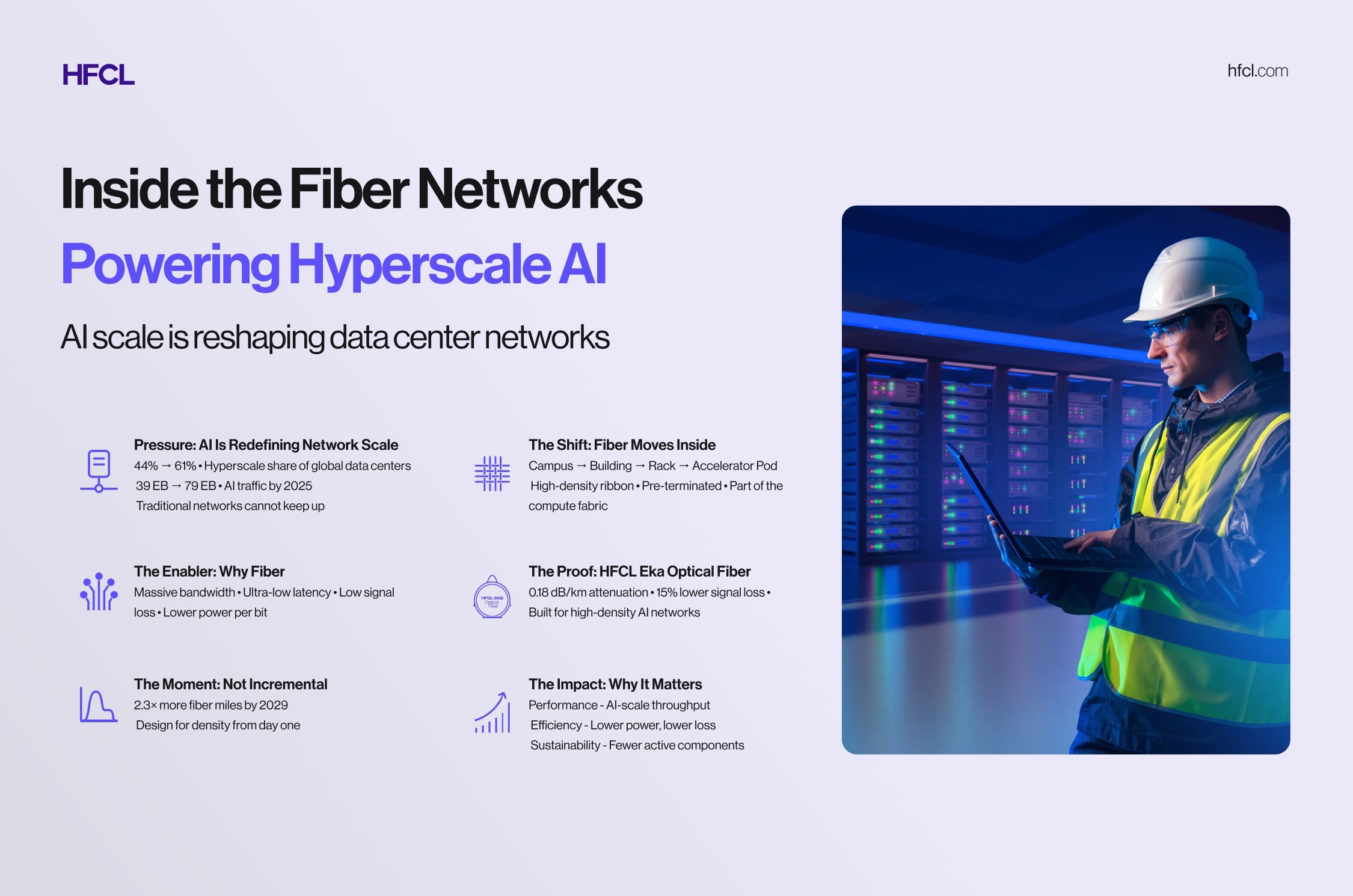
Think about this: hyperscale operators now control 44% of global data center capacity, and analysts expect this share to grow to 61% by 2030. (Source: Data Center Frontier)
AI traffic is expected to double in 2025, rising from 39 exabytes to 79 exabytes. This growth far outpaces traditional applications. (Source: Network World) We are witnessing a tectonic shift in demand, and the networks behind it must evolve just as radically.
Why We Are at an Inflection Point
In the past, fiber was mainly used for long-distance links between cities and metro backbones. Now, with AI’s appetite for data, fiber has become the fabric of modern compute.
Hyperscale campuses are building fiber-rich nervous systems that connect thousands of strands across buildings, clusters, racks, and accelerator pods. New innovations are emerging to handle this scale, such as ultra-dense ribbon designs, bend-insensitive profiles, and modular plug-and-play systems.
Research from the Fiber Broadband Association shows that, to support AI growth in the U.S., fiber deployment must increase by 2.3 times in total miles and 2 times in routes by 2029. That is not incremental growth, it is exponential.
The investment signals are already clear. In metro markets, fiber acquisitions soared 268% between 2023 and 2024, while long-haul fiber deals rose 52.6% in the same period. (Source: RCR Wireless News)
The Payoff: Why It Matters
This transformation is not just about moving larger volumes of data. It is about building networks that unlock new levels of performance, scale efficiently as demand soars, and deliver reliability at hyperscale. At the same time, operators must achieve all of this while keeping costs under control and advancing sustainability goals. The right fiber infrastructure does not just support AI growth, it enables it.
Performance That Keeps Up
AI clusters operate in tightly synchronized meshes where latency, jitter, and signal variation can compromise performance. Optical technologies already demonstrate 1.7 Tb/s single-channel transmission and 56.5 Tb/s on DWDM links over 96 km using standard single-mode fiber. (Source: arXiv) That level of throughput allows GPU clusters to exchange data at full speed without bottlenecks.
Scaling Without Rebuilding
Constantly laying new ducts or conduits is not practical. The key is densification, which means packing more fibers into the same footprint, using bend-insensitive designs, and leveraging high-count ribbon cables. The cabling market is already expanding, valued at USD 7.1 billion in 2024 and projected to grow at ~8.9% annually through 2034. (Source: Global Market Insights Inc.)
Efficiency in Power and Cost
Data movement consumes energy, but fiber helps keep power in check. Goldman Sachs forecasts that data center power demand could increase by 165% by 2030 compared to 2023, driven largely by AI workloads. (Source: Goldman Sachs) Fiber’s lower signal loss and reduced need for amplifiers or repeaters help offset this rise.
At the same time, McKinsey projects that building AI-ready data centers will require USD 5.2 trillion by 2030, part of a broader USD 6.7 trillion investment in global compute infrastructure. (Source: McKinsey & Company) With this level of capital pressure, cost per bit and operational efficiency are mission-critical.
Reliability That Matters
High-speed, dense environments cannot afford signal drift or downtime. Modern fiber designs, especially those with bend tolerance and reduced microbend loss, ensure stability in compact deployments and support always-on AI services.
Green as a Competitive Edge
Data centers already consume massive amounts of electricity. With AI accelerating demand, efficiency is now a sustainability issue. Lower-loss fibers, fewer active components, and smarter routing directly reduce energy use and carbon emissions.
Navigating Deployment: What Truly Works
Deploying fiber at hyperscale is less about glamour and more about meticulous execution. The operators that succeed are the ones who anticipate challenges and design around them.
- ● Plan for density from day one with pathways and spare capacity built in
- ● Use modular, preterminated assemblies to speed up rollout and reduce errors
- ● Incorporate bend-insensitive designs and micro-duct strategies for compact environments
- ● Ensure future compatibility with co-packaged optics and advanced modulation schemes
- ● Maintain discipline in labeling, routing, and monitoring as fiber counts climb into the thousands
Our Edge: Why We Lead
Meeting the demands of AI-scale networks requires more than just adding capacity. It requires fiber designed for performance, efficiency, and longevity. This is where HFCL’s Eka Optical Fiber sets a new benchmark.
Eka is engineered with precision and delivers:
- ● 15% lower signal loss, ensuring cleaner signals over longer distances
- ● 10% greater network reach, extending performance for metro and long-haul links
- ● 20% improved coverage area, reducing the need for amplifiers and saving energy
With attenuation as low as 0.18 dB/km at 1550 nm, Eka is built for bandwidth-heavy AI workloads. Its macro-bending resilience, exceeding ITU-T G.657.A1 standards, guarantees dependable performance even in the tight, high-density routing environments of hyperscale campuses.
From long-haul and metro routes to FTTX and last-mile connectivity, Eka is designed to scale faster, operate greener, and deliver greater confidence for hyperscalers preparing for the AI era.
Peering Around the Bend: What’s Next
The future of fiber in AI networks is evolving rapidly.
- ● All-optical interiors will replace short-reach copper links inside racks
- ● Chip-fiber convergence through co-packaged optics will cut power use and boost efficiency
- ● AI-optimized backbones across regions and oceans will require lower loss and higher spectral efficiency
- ● Intelligent management systems will use AI for fault detection, self-healing, and predictive monitoring as fiber counts scale into the tens of thousands
Challenges remain, from duct capacity to labor shortages and legacy compatibility, but the direction is clear. Those investing in next-generation connectivity now will lead in the AI economy.
Final Thoughts
We are in the middle of a fast-forward moment. AI workloads are redefining scale, and the networks behind them must not just keep pace, they must anticipate and accelerate. Companies that invest today in scalable, reliable, and sustainable connectivity will be the ones anchoring the AI era.
HFCL’s Eka Optical Fiber is built for this future, helping hyperscalers light the path ahead.