Global data center infrastructure is now one of the fastest-growing energy consumers on the planet. According to the IEA's Energy and AI report (2025), electricity demand from data centers reached 415 TWh in 2024 and has already scaled to an estimated 860 TWh in 2025 growing at roughly 15% per year. The IEA's mid-year electricity update projects demand will reach 945 TWh by 2030, equivalent to nearly 3% of all global electricity. The scale of this challenge demands a fundamental rethink of every layer of data center design including the cables.
Copper-based network cabling silently converts a significant share of transmission energy into heat that cooling systems must then remove at additional cost. Upgrading to fiber optic infrastructure is one of the most direct, measurable actions an operator can take to improve data center sustainability without sacrificing performance. This article puts the latest 2025-2026 data behind that claim.
The Energy Crisis Inside Today's Data Center Infrastructure
The Uptime Institute's 15th Annual Global Data Center Survey (2025), published in July 2025, found that industry average Power Usage Effectiveness (PUE) stands at 1.54 virtually unchanged for the sixth consecutive year. For every unit of energy reaching IT equipment, an additional 54% is consumed by cooling, power distribution, and lighting overhead. The survey notes that improvements are 'constrained by legacy infrastructure and region-specific barriers to efficient cooling.'
The European Commission's November 2025 data center energy focus confirms that EU data centers consumed 70 TWh in 2024, projected to grow to 115 TWh by 2030. Meanwhile, the World Economic Forum (December 2025) notes that training a single large AI model generates an estimated 552 tonnes of CO2 equivalent to the annual footprint of 121 households. In this environment, cable-level heat generation is no longer a minor footnote. It is a measurable contributor to a facility's total carbon and energy burden.
28 AWG vs 26 AWG Copper vs Optical Fiber Cable:
The choice of data center cabling determines how much energy escapes as heat before reaching a single workload. The table below, drawing on data from Inneos, Anixter, and FOCC Fiber, compares the three most common cabling types in active deployments:
| Cable Type | Heat / Energy Loss | Max Distance | Power per 10G Port |
|---|---|---|---|
| 28 AWG Copper Patch | High internal heat retention; worst I2R loss in class | Up to 7 m | 5-8+ W per port |
| 26 AWG Copper Patch | 30-35% energy lost as heat during transmission | Up to 15 m | 4-6 W per port |
| Cat6A Copper Structured | Significant ohmic heat; burdens cooling systems | 100 m | 3-5 W per port |
| Optical Fiber Cable | Only 5-6% optical attenuation; near-zero heat | 10 km+ (SM) | < 1 W per port |
28 AWG Copper: Heat Retention and I2R Loss Explained
28 AWG copper patch cables carry higher electrical resistance per unit length than standard 23-24 AWG conductors. A technical analysis by FOCC Fiber[7] confirms that the reduced diameter makes 28 AWG cables especially vulnerable to I2R energy loss -- energy that converts to heat trapped inside dense cable bundles. In rack-dense AI environments, where server rack power densities are already rising into the 10-30 kW range[4] per the Uptime Institute 2025 survey, this trapped cable heat compounds the cooling challenge further.
26 AWG Copper: A 30-35% Energy Loss You Are Paying For
26 AWG copper cables remain a common choice for structured network cabling, yet still exhibit 30-35% energy loss as heat during transmission under typical load conditions. Inneos[8] shows that a standard 10 Gbps copper Ethernet link (Cat6A, 26 AWG) consumes 5 to 8+ watts per port. Across 50,000 ports in a modern hyperscale facility there are now 1,297 operational hyperscale data centers[9] worldwide as of late 2025 that translates to up to 400 kW of cable-generated heat load before counting a single server.
Optical Fiber Cable: 5-6% Attenuation, Near-Zero Heat Generation
Optical fiber cable transmits data as pulses of light through a glass or silica core. Light encounters no electrical resistance there is no I2R heating. The only loss is optical attenuation, which Inneos[8] confirms sits at just 5-6% over standard intra-data-center link lengths. The same source shows an equivalent fiber optic 10G link consumes less than 1 watt per port an energy reduction of up to 85% per port versus copper. This physical difference also means AI data centers require up to 36x more optical fiber than traditional CPU-based racks -- not because fiber is an upgrade, but because it is the only medium capable of sustaining the bandwidth and thermal requirements of modern GPU clusters.
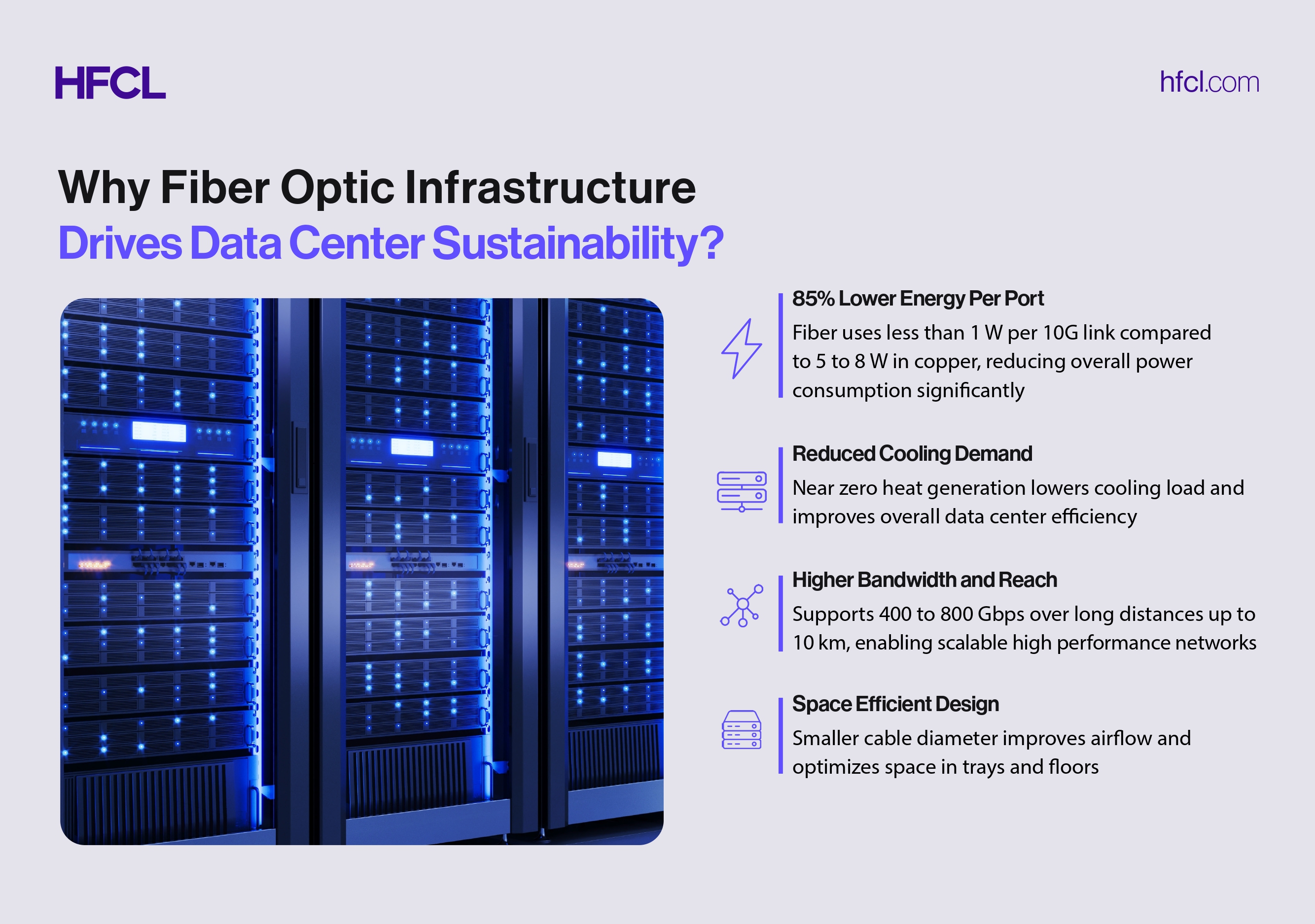
5 Ways Fiber Optic Networks Drive Data Center Sustainability
1. Up to 85% Less Energy Per Port with Proven PUE Improvement
Switching from copper to optical fiber cuts per-port power consumption from 5-8 W to under 1 W. At hyperscale, Holight Optic (October 2025) documents that switching large-scale intra-data-center interconnects from copper to fiber delivers 8-12% PUE improvement, representing millions of dollars saved annually and measurable CO2 reduction. Anixter adds that pre-terminated high-density fiber systems deploy up to 75% faster than copper, reducing installation cost and downtime from day one.
2. Reduced Cooling Load and Better Airflow
Optical fiber cable is approximately one-quarter the physical diameter of a Cat6 copper cable. Anixter confirms high-density fiber frees critical pathway space in cable trays and under raised floors, allowing cooled air to circulate more effectively. With cooling consuming over half of non-IT overhead in many facilities, reducing cable bulk is a direct efficiency lever -- not a marginal one.
3. The Foundation AI Infrastructure Cannot Build Without
The Fiber Broadband Association's July 2025 research report states plainly: the U.S. will need a 2x increase in fiber route miles and a 2.3x increase in total fiber miles by 2029 to support AI data center growth. STL CEO Rahul Puri (December 2025) confirmed that AI-focused data centers require 36x more fiber than traditional CPU-based racks. Meanwhile, 800G optical modules are now the default choice for new AI data center buildouts in 2025, with 1.6T transceivers entering deployment. Only fiber optic networks can support these speeds.
4. Carbon and ESG Impact at Scale
The World Economic Forum (December 2025) highlights that data centers operating near PUE 1.1 use dramatically less overhead energy than those at 2.0 -- and fiber optic infrastructure directly enables that improvement. Hyperscaler capex is forecast to exceed $600 billion in 2026, with roughly 75% tied to AI infrastructure. As this investment scales, every watt saved per terabit transmitted counts toward Scope 2 emissions reductions, ESG reporting obligations, and compliance with frameworks such as the EU Energy Efficiency Directive.
5. Future-Ready: 800G Today, 1.6T Tomorrow
By 2025, 800G optical modules are the standard for new AI data center deployments. 800G optics shipments grew 60% in 2025 following 250% year-on-year growth for 400G+ transceivers in 2024. IEEE ComSoc (December 2025) reports that Corning's enterprise fiber sales grew 58% year-on-year in Q3 2025, driven by AI network demand. Organizations deploying fiber optic infrastructure today upgrade transceivers as speeds evolve -- they do not replace cables, avoiding costly and disruptive rip-and-replace cycles.
How HFCL's Fiber Optic Infrastructure Supports Green Data Centers
HFCL designs and manufactures optical fiber cable and structured fiber optic networks for the density, performance, and efficiency demands of modern data center infrastructure. Our portfolio covers every layer of the physical network:
High fiber count cables and microcables
significantly smaller outer diameter than copper bundles, reducing cable tray fill, improving airflow, and directly supporting data center cooling efficiency.
MPO pre-terminated fiber assemblies
factory-terminated for zero on-site error, cutting deployment time by up to 75% and enabling rapid scale-up of high-density fiber optic networks.
Fiber distribution systems and fiber patch panels
organized, auditable data center cabling management that simplifies capacity planning and reduces maintenance downtime.
OS2 single-mode and OM3/OM4/OM5 multimode optical fiber
full compatibility with 100G, 400G, and 800G transceivers, ready for the 1.6T generation entering deployment in 2026.
HFCL's optical fiber cables are manufactured from silicon dioxide (silica) one of the most abundant and sustainably extracted materials on earth. Unlike copper, silica production does not carry the same environmental extraction burden, making optical fiber cable the more sustainable choice across its entire lifecycle.
Conclusion
The numbers from 2025-2026 leave no room for ambiguity. Global data center electricity demand reached 860 TWh in 2025 and is on course to reach 945 TWh by 2030. Industry PUE remains stubbornly at 1.54 for the sixth consecutive year. AI data centers require 36x more fiber than their predecessors. And the U.S. alone needs to more than double its fiber infrastructure by 2029 to support this growth.
28 AWG and 26 AWG copper cables dissipate 30-35% of transmission energy as heat. Optical fiber cable loses just 5-6% to attenuation, generates virtually no heat, consumes under 1 W per 10G port versus 5-8 W for copper, and delivers 8-12% PUE improvement when deployed at scale.
For operators building sustainable data centers for an AI-first world, the physical layer is not a cost line, it is a foundation. HFCL's fiber optic infrastructure from high-count microcables to MPO systems and structured network cabling solutions gives your team the tools to build a green data center that is faster, more scalable, and verifiably more energy efficient.