Artificial intelligence, cloud platforms, and edge computing are rapidly changing data center network design. Modern AI data centers process massive data volumes and connect thousands of GPUs. These systems require very fast and reliable connectivity.
Organizations continue to invest heavily in AI infrastructure and cloud infrastructure. Because of this, the demand for stronger data center infrastructure, advanced networking equipment, and efficient fiber optic networks keeps increasing.
In the past, traditionally data centers focused mainly on storage and enterprise applications. They did not need to handle the heavy internal data traffic created by AI workloads. Today, hyperscale environments generate large volumes of internal data exchange between servers, GPUs, and storage systems.
Because of this shift, operators must redesign network infrastructure, fiber optic cable systems, and structured cabling architectures. These upgrades help support higher bandwidth, lower latency, and improved reliability.
AI and Cloud Driving Data Center Growth
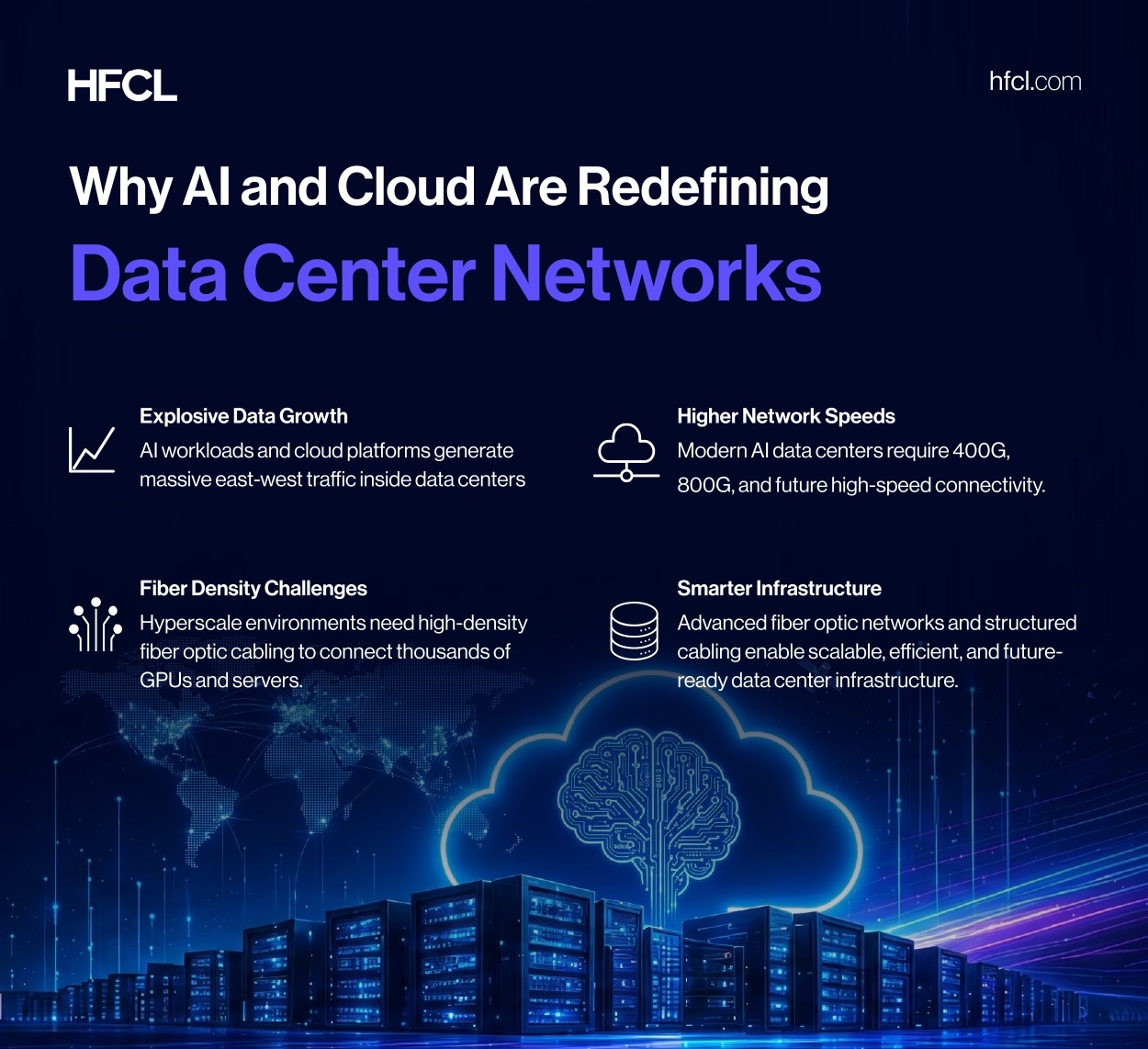
The growth of AI infrastructure is one of the main reasons for modern data center expansion. AI workloads require thousands of GPUs to communicate continuously. This generates huge volumes of east-west traffic within the fiber optic network.
At the same time, companies are expanding cloud infrastructure to support digital services and applications worldwide. This growth drives the development of large hyperscale data centers.
These hyperscale facilities rely heavily on advanced data center cabling, optical fiber networks, and high-performance network infrastructure. These technologies help maintain reliable connectivity while handling massive workloads.
Edge computing also adds complexity. Data processing now happens closer to users, which requires flexible and scalable fiber network infrastructure.
Key Challenges in Modern Data Center Networks
1. Scaling Network Infrastructure
AI workloads require extremely high bandwidth. As GPU clusters expand, the network infrastructure must grow as well. High-capacity fiber optic cable systems enable faster data transfer and better network performance.
2. Managing Fiber Density
Modern data center cabling systems include thousands of fiber connections. Without proper planning, dense cabling can become difficult to manage. Efficient structured cabling systems help organize fiber networks and simplify maintenance.
3. Faster Deployment
Hyperscale operators must deploy new infrastructure quickly. Rapid deployment helps them keep up with cloud expansion and AI demand. Reliable fiber optic connectivity solutions reduce installation time and simplify upgrades.
4. Cooling and Airflow Management
Large AI clusters generate significant heat. Efficient cooling systems are necessary to maintain stable performance. Excessive cable bulk can block airflow and reduce cooling efficiency. Compact fiber cables help maintain proper airflow inside racks.
5. Maintaining Signal Quality
As network speeds reach 400G and beyond, maintaining signal quality becomes essential. High-quality optical fiber networks and fiber optic cable systems ensure reliable high-speed communication.
Why Fiber Optic Infrastructure Matters
Modern data center infrastructure depends heavily on fiber optic networks. Optical fiber enables faster speeds, lower latency, and better reliability than traditional copper cables.
High-density fiber optic cabling allows operators to connect thousands of servers while using limited space. Efficient data center cabling systems also improve cable organization and simplify network expansion.
Well-designed structured cabling ensures that data centers remain efficient as network demand grows.
HFCL Solutions for High-Performance Data Centers
HFCL provides advanced solutions for modern hyperscale data centers and enterprise networking environments.
High-Fiber-Count Microcables
HFCL microcables support ultra-dense fiber optic cable deployments. Their compact design reduces cable bulk and improves airflow within racks. This helps maintain effective cooling systems.
Structured Cabling Solutions
HFCL offers scalable structured cabling systems designed for high-speed data center networking. These systems support organized cable management and easier upgrades.
MPO Optical Connectivity
HFCL provides MPO fiber solutions that simplify large-scale deployments. Pre-terminated connectivity allows faster installation of fiber optic networks.
Reliable Optical Components
HFCL also supplies fiber patch cords, connectors, and fiber distribution systems. These components ensure stable connectivity and maintain signal quality across high-speed networks.
Future of Data Center Networks
AI and cloud computing will continue to increase demand for high-performance data center networks. Operators must build infrastructure that supports growing workloads and evolving technologies.
Future hyperscale data centers will rely on advanced fiber optic connectivity, efficient data center cabling, and scalable networking equipment.
With the right fiber infrastructure and connectivity solutions, organizations can build reliable and efficient networks that support AI, cloud services, and next-generation digital platforms.
Conclusion
The rapid growth of AI data centers, cloud infrastructure, and hyperscale networks is transforming data center network design. High-density fiber optic cable systems, advanced structured cabling, and reliable optical fiber networks now play a critical role in modern infrastructure.
By adopting advanced fiber connectivity solutions and efficient networking equipment, operators can solve challenges related to bandwidth, deployment speed, and cooling efficiency.
Modern data center infrastructure will continue to power AI innovation, cloud services, and the next generation of digital platforms.