Data center infrastructure is scaling at a pace the industry has never seen before. Zayo's Bandwidth Report (November 2025) found that bandwidth purchased for data center connectivity surged by 330% between 2020 and 2024, driven primarily by hyperscale expansion and AI workloads. Meanwhile, the Fiber Broadband Association (July 2025) confirms that AI-focused data centers need 36 times more optical fiber than traditional CPU-based racks.
Traditional fiber optic cabling approaches were not designed for this environment. Modern AI clusters, hyperscale cloud facilities, and colocation hubs require high-density fiber cabling compact, high-capacity optical fiber systems that maximize connectivity within limited physical space. This blog explains what high-density fiber optic cable infrastructure is, why demand is accelerating in 2025-2026, and the best practices organizations need to deploy it effectively.
What is High-Density Fiber Cabling?
High-density fiber cabling refers to fiber optic cable systems that support a large number of connections within a minimal physical footprint. These systems use advanced designs including high fiber count cables, MPO (Multi-Fiber Push-On) connectivity, modular cassette systems, and fiber patch panels all of which consolidate many individual connections into compact, organized assemblies.
Unlike conventional fiber optic cabling that uses one connector per fiber, a single MPO connector can house 12, 24, or up to 72 fibres. According to Holight Optic (October 2025), factory-terminated MPO cables reduce on-site splicing time by up to 70% versus traditional termination methods. Corning's 2026 data center predictions describe the shift toward 'thousands of fibres per run' inside AI campuses a clear signal that density, not just speed, is now the defining metric of fiber optic infrastructure.
Why Data Centers Need High-Density Fiber Cabling Solution?
The growth statistics from 2025-2026 make the case plainly. The global data center cabling market was valued at USD 7.7 billion in 2025 and is projected to reach USD 18.1 billion by 2035 at a CAGR of 8.9%, with fiber optic cables commanding a 59.3% market share per Future Market Insights. Within that, the data center cabling sub-segment is growing at 12% CAGR through 2035 -- the highest rate in the market.
The Uptime Institute's 2025 Global Survey confirms that average server rack power densities continue to rise into the 10-30 kW range, driving demand for denser optical fiber interconnects. Corning's VP John McGirr reported enterprise fiber sales grew 58% year-on-year in Q3 2025, while STL CEO Rahul Puri (Fierce Network, December 2025) stated: AI data centers need 36 times more fiber than traditional CPU-based racks to handle GPU cluster connectivity.
Inside the data center network architecture, AI workloads generate massive east-west traffic GPU-to-GPU communication across thousands of parallel links. FS (2025) documents that configuring 56 server units with over 2,000 DGX H100 nodes would require 16,384 individual cables using traditional cabling. A 144-fibre MPO trunk cable consolidates this into a fraction of that count making high-density structured cabling not optional, but operationally essential.
Key Benefits of High-Density Fiber Optic Cabling
1. Improved Space Utilization and Rack Density
High-density fiber optic cabling systems save over 50% of pathway space compared to traditional cabling approaches. UnitekFiber documents that MPO/MTP trunk systems reduce large congested cable bundles in routing routes by more than half. Rosenberger's data center cabling research shows that ultra-high-density panel systems can support up to 4,200 ports per square metre of data center floor space. For AI facilities where every U of rack space translates directly to compute revenue, this space efficiency has measurable financial value.
2. Reduced Cable Congestion and Better Airflow
Dense conventional cabling creates 'cable dams' that block hot-aisle/cold-aisle airflow paths, forcing cooling systems to work harder. High-density fiber optic cable assemblies are significantly smaller in diameter than copper bundles and are routed in clean, organized trunks. Holight Optic (October 2025) confirms that switching to fiber optic infrastructure delivers an 8-12% PUE improvement at hyperscale -- translating to millions of dollars in annual energy savings and direct CO2 reduction. The EU Energy Efficiency Directive requires data centers to achieve PUE below 1.3 by 2030, making airflow-friendly fiber optic cabling a compliance necessity, not just a performance preference.
3. Scalability for 400G, 800G, and Beyond
800G optical modules became the default standard for new AI data center buildouts in 2025, with 800G optics shipments growing 60% year-on-year. Introl (2025) reports that 1.6T transceivers are entering broader commercialisation in 2026. High-density fiber optic cabling systems are designed to support these migrations without re-cabling -- operators upgrade transceivers and cassettes, not the physical cable plant. FS (2025) documents that modular MPO systems allow seamless upgrades from 40G to 100G/400G networks by changing only the cassettes on both sides, protecting the infrastructure investment across multiple technology generations.
4. Faster Deployment With MPO Pre-Terminated Assemblies
Factory-terminated MPO trunk systems are the single fastest deployment advance in modern data center cabling. UnitekFiber reports that high-density MPO/MTP trunk cables save 80% of installation time versus traditional fiber optic cabling methods. Holight Optic (October 2025) documented a real-world AI facility deployment of 8,000 GPUs where pre-terminated MTP-16 trunk cables cut installation time by 65%, with factory-verified average insertion loss of 0.19 dB per channel. This speed advantage directly reduces commissioning time, which is critical as Corning (2026) notes that hyperscalers are shifting toward factory-built integration to 'move labor off the critical path.'
5. Lower Total Cost of Ownership
Although high-density fiber cabling carries a higher upfront cost than conventional approaches, the total cost of ownership is substantially lower. Holight Optic (October 2025) calculates that even with a 25% CAPEX increase, fiber's efficiency gains cut OPEX sufficiently to achieve payback within 18 months. Reduced installation labour (80% time saving), lower cooling costs from improved airflow, and elimination of rip-and-replace upgrade cycles across 400G-to-800G transitions all compound this TCO advantage over a standard 10-year infrastructure lifecycle.
Challenges in High-Density Data Center Cabling
High-density fiber optic infrastructure delivers substantial benefits, but organisations must plan carefully for these technical realities:
| Challenge | How to Address It |
|---|---|
| Cable Management Complexity | Use modular fiber distribution systems with clear labelling, colour coding, and documentation standards aligned to TIA-942 or ISO/IEC 11801. |
| Installation Precision | Deploy factory-terminated MPO assemblies with IEC 61300 and GR-326 certification to eliminate on-site termination error. |
| Signal Integrity at High Speeds | Select bend-insensitive G.657.A1 optical fiber with MPO insertion loss below 0.15 dB and 100% factory-tested assemblies. |
| Maintenance in Dense Environments | Design with modular cassette systems and hot-aisle/cold-aisle containment -- avoid point-to-point cabling architectures in high-density zones. |
Data Center Cabling Best Practices for High-Density Environments
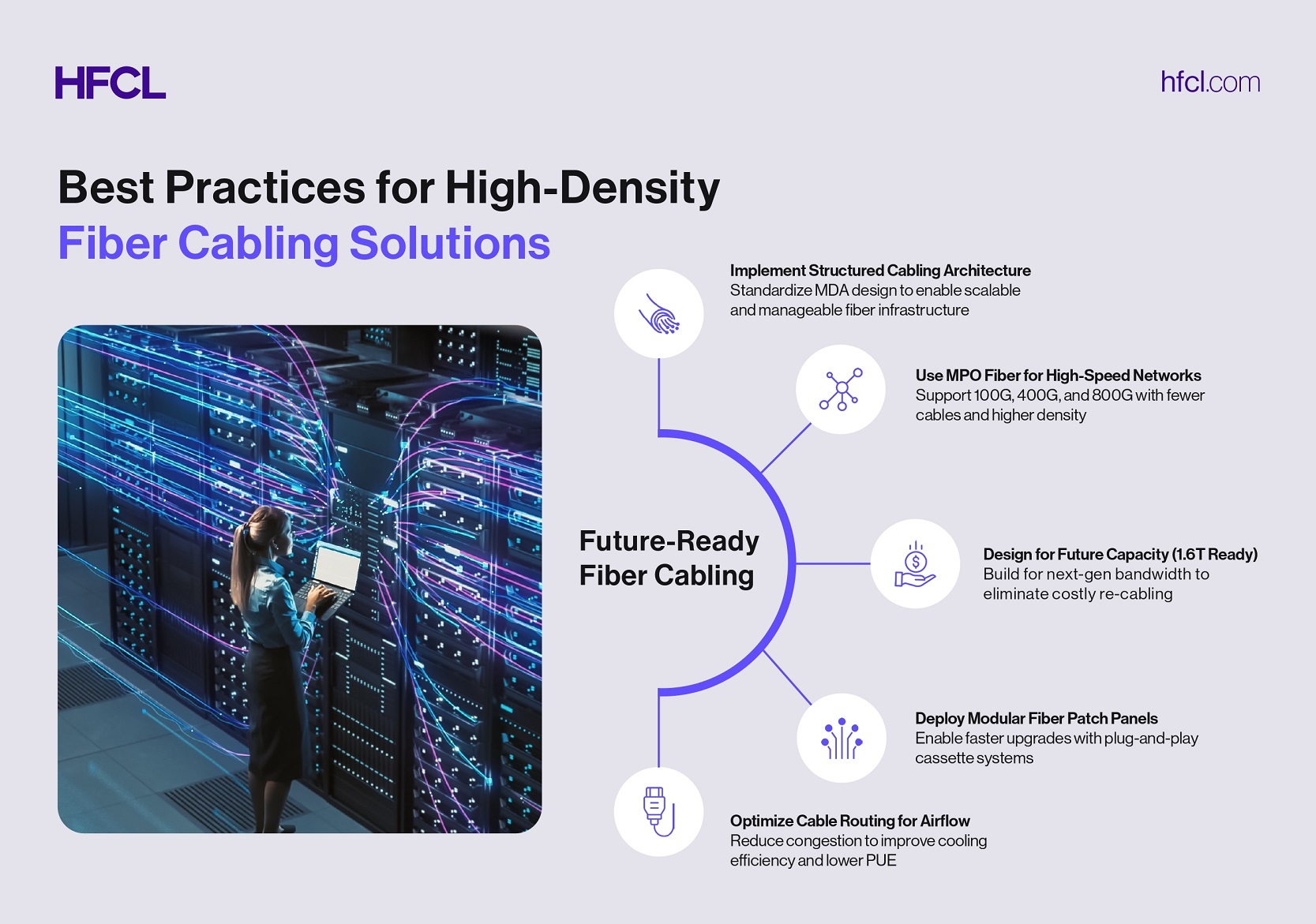
- Implement Structured Cabling Architecture First. Design a main distribution area (MDA) with organised cable pathways and standardised patch zones before deployment. Structured cabling simplifies moves, adds, and changes (MACs) and eliminates the point-to-point cable chaos that makes dense environments unmanageable at scale.
- Adopt MPO Fiber Connectivity for Backbone Links. Use MPO 12-fibre trunks for 100G/400G links and MPO 8-fibre for 800G parallel optics architectures. This single choice reduces backbone cable count, improves airflow, and enables cassette-level upgrades without touching the physical plant.
- Plan Scalability Into the Physical Design. Size conduit, trays, and distribution frames for at least two capacity generations beyond current requirements. As Corning (2026) notes, 2026 will see 'thousands of fibers per run' in AI campus deployments -- design for this from day one.
- Use Modular Fiber Distribution Systems and Fiber Patch Panels. Modular cassette systems allow independent zone upgrades without disrupting adjacent links. Fiber patch panels with hot-swappable cassettes reduce maintenance windows and support future 1.6T transceiver migrations.
- Optimize for Airflow and Cooling Compliance. Route fiber optic cabling through overhead trays rather than underfloor where possible to maintain hot-aisle containment. Reducing cable bulk in cold-aisle zones is one of the most direct pathways to achieving the EU's PUE target of 1.3 by 2030.
How HFCL's Fiber Optic Infrastructure Supports High-Density Data Centers?
HFCL designs and manufactures optical fiber cable and fiber optic cabling solutions purpose-built for the density, performance, and scalability demands of modern data center infrastructure. Our portfolio addresses every layer of the physical network:
- • High fiber count cables and microcables -- ultra-dense optical fiber designs that maximize fibre count per unit diameter, reducing pathway fill and improving airflow within structured cabling
- • MPO pre-terminated fiber assemblies -- factory-terminated to IEC 61300 standards, cutting data center cabling deployment time by up to 80% and eliminating on-site termination error in high-density environments.
- • Fiber patch panels and fiber distribution systems -- modular, hot-swap cassette architecture that supports organised fiber optic infrastructure management with clean documentation and rapid maintenance access.
- • OS2 single-mode and OM3/OM4/OM5 multimode optical fiber -- full compatibility with current 100G/400G/800G transceivers and the 1.6T generation entering deployment in 2026, protecting your fiber optic cabling investment across multiple technology cycles.
Conclusion
The data from 2025-2026 is unambiguous. Data center bandwidth grew 330% in four years. AI racks need 36 times more fiber than traditional deployments. The data center cabling market is on course to reach USD 18.1 billion by 2035. 800G is the new standard, and 1.6T is entering deployment in 2026.
High-density fiber cabling built on optical fiber cable, MPO pre-terminated assemblies, modular fiber patch panels, and structured cabling architecture is not a future-state aspiration. It is the present-tense requirement for any data center expected to support AI workloads, hyperscale operations, and 800G+ networking in the years ahead.
HFCL's fiber optic infrastructure solutions from high-count microcables to MPO systems and fiber optic cabling distribution components give data center operators a proven, scalable foundation. The organisations investing in high-density optical fiber today are the ones that will expand faster, cool more efficiently, and upgrade more affordably tomorrow.