As global networks scale to meet the demands of 5G, cloud, FTTH, and hyperscale data centers, operators face the challenge of delivering faster speeds, higher capacity, and more efficient space utilization. At HFCL, we address this challenge with our next-generation fiber ribbon cables, engineered for high-density deployments without compromising flexibility or performance.
One of our most advanced innovations is the IBR (Intermittently Bonded Ribbon) cable, which offers the splicing efficiency of traditional ribbon cables with the flexibility of loose tube designs. This unique combination enables network operators to accelerate rollouts, optimize duct space, and ensure long-term scalability.
What is a Fiber Ribbon Cable?
A fiber ribbon cable is designed to bundle multiple fibers together in a flat ribbon formation. This allows for simultaneous splicing of up to 12 fibers, drastically reducing installation time and cost. HFCL’s ribbon cables are purpose-built for high-density environments where speed and reliability are paramount
Why HFCL Fiber Ribbon Cables Matter
- • Faster mass fusion splicing for quicker deployments
- • Higher fiber density in limited duct space
- • Lower project costs through installation efficiency
- • Proven durability in harsh environments
Standard Ribbon vs HFCL’s IBR Cables
Traditional ribbon cables are effective but can be rigid during routing, while loose tube designs, though flexible, slow down deployment due to single-fiber splicing. HFCL bridges this gap with IBR cables, where fibers are bonded at intervals. This ensures easier handling while retaining the speed advantage of ribbon splicing.
- • Standard Ribbon Cable: Fully bonded, efficient splicing, less flexible.
- • Loose Tube Cable: Flexible, but time-consuming for splicing.
- • HFCL IBR Cable: Hybrid solution—splicing efficiency + routing flexibility.
Ribbon vs Loose Tube Fiber: A Quick Comparison
| Feature | Ribbon Fiber | Loose Tube Fiber | HFCL IBR Cable |
|---|---|---|---|
| Fiber Density | Very High | Medium | Very High |
| Splicing Speed | Fast (mass fusion) | Slow (single fiber) | Fast + Flexible |
| Routing Flexibility | Low | High | Medium–High |
| Best Use | Data centers, metro networks | Long-haul, outdoor | Data centers, FTTH, 5G |
Why HFCL’s IBR Cable Stands Out in High-Density Networks
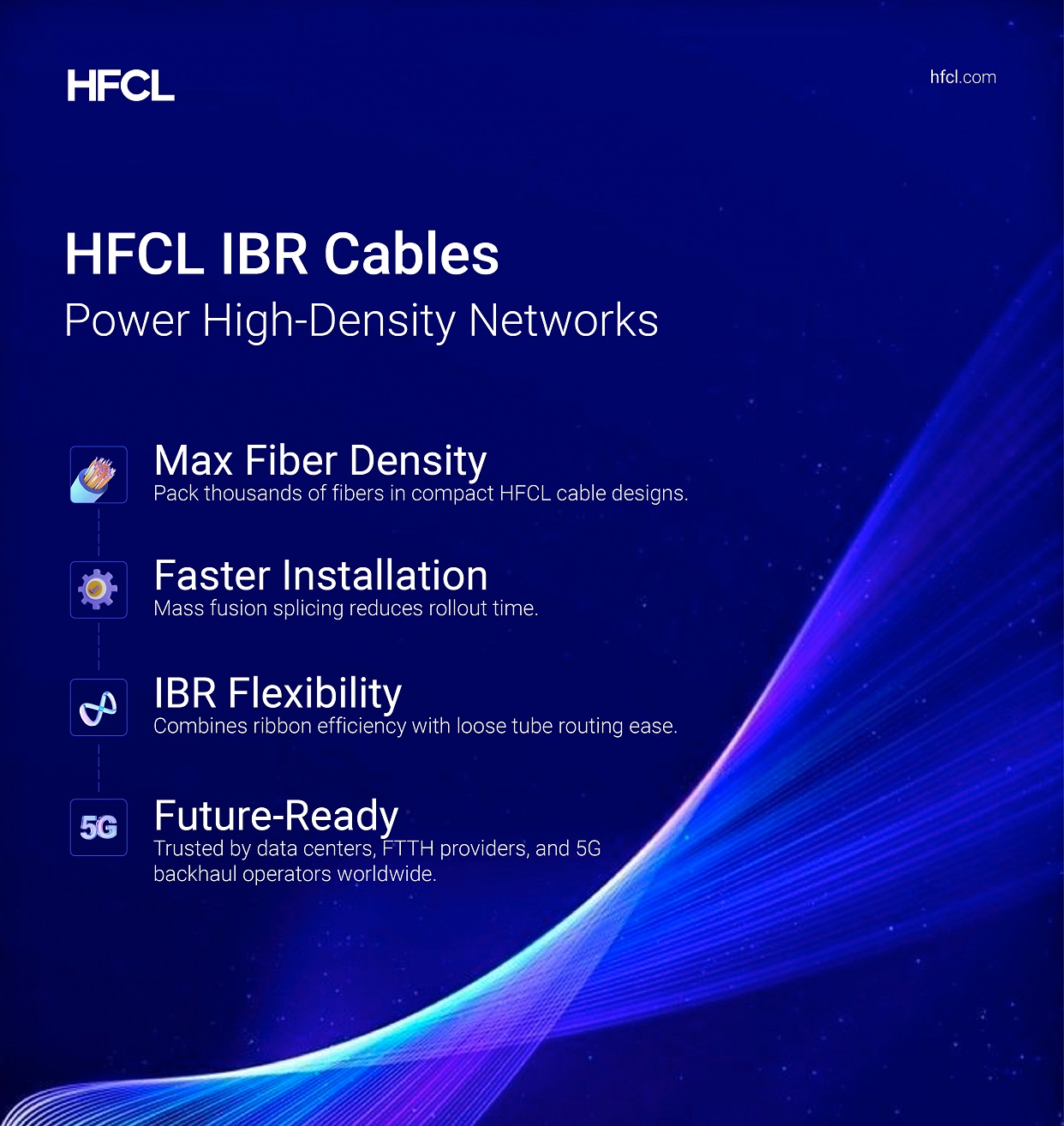
HFCL’s IBR cable is engineered for hyperscale and high-capacity networks, delivering unmatched efficiency. By reducing duct occupancy and simplifying installation, our solution lowers the total cost of ownership for operators.
In fact, a U.S. hyperscale tech giant doubled its network performance with HFCL’s compact IBR cable, proving our cables’ impact in real-world high-density deployments.
Key Advantages of HFCL IBR Cables:
- • Compact size with thousands of fibers
- • Superior bend performance for tight routing
- • Faster rollouts through mass fusion splicing
- • Future-ready solution for 5G, FTTH, and data centers
Applications of HFCL Fiber Ribbon and IBR Cables
- Hyperscale Data Centers: Optimize cabling in space-constrained environments.
- 5G Backhaul: Deliver low-latency, high-capacity connectivity.
- FTTH Networks: Enable faster fiber-to-the-home rollouts.
- Metro & Campus Networks: Improve efficiency in high-density urban deployments.
Conclusion
At HFCL, we are redefining network expansion with fiber ribbon and IBR cables designed for today’s and tomorrow’s connectivity needs. By combining density, flexibility, and scalability, our solutions empower operators to build future-ready, cost-efficient networks.
Whether it’s hyperscale data centers, 5G backhaul, or FTTH, HFCL’s intermittently bonded ribbon cables ensure superior performance, proven by global deployments.