As fiber deployments gain momentum, they are increasingly being deployed closer to the end users, leading to an increasing demand for fibers that can be easily and quickly installed in constrained spaces.
In these situations, the Fiber-to-the-Home (FTTH) networks have to be routed through several narrow bends and corners during installations. Unfortunately, contracted bending radii leads to higher attenuation and loss of light. This is mainly because Single Mode Fibers were not designed for deployment in these settings. There was a need for fibers that could be easily deployed in constricted spaces without leading to any loss of signal. This is one of the key reasons for the ever-increasing demand for Bend Insensitive Fibers.
The International Telecommunication Union (ITU-T), a UN agency that formulates standards for telecommunications and information technologies, divides single-mode fibers into six categories of G.652, G.653, G.654, G.655, G.656, and G.657. The G.657 standards were developed to address the growing demand for more resilient and robust fibers that can be deployed in tight spaces.
Single-mode fibers compliant with G.657 standards have small bending radii and are designed for deployment in confined areas. These kinds of fibers are also known as Bend-Insensitive (BI) or Reduced-Bend-Insensitive (RBI) fiber cables.
Because of their low attenuation properties, single-mode or mono mode fibers are extremely popular with network operators for long-distance transmission, cable television, telephone, and internet networks. Single-mode optic fiber cables have a single path for light to travel and a small core size of around 8 to 10 µm.
Understanding ITU-T G.657.A1 and G.657.A2 single-mode fibers
In this article, we will be discussing three of the four variants of G.657 standards. The ITU-T G.657 fiber cables are further divided into two categories: Category A and Category B. While Category A is for access networks, Category B is typically used for short distances (of less than one kilometer) at the end of access networks in environments that require intense bending, such as buildings.
These two categories are further divided into two sub-categories. Category A is divided into ITU-T G.657.A1 and ITU-T G.657.A2 and Category B is divided into ITU-T G.657.B2 and ITU-T G.657.B3.
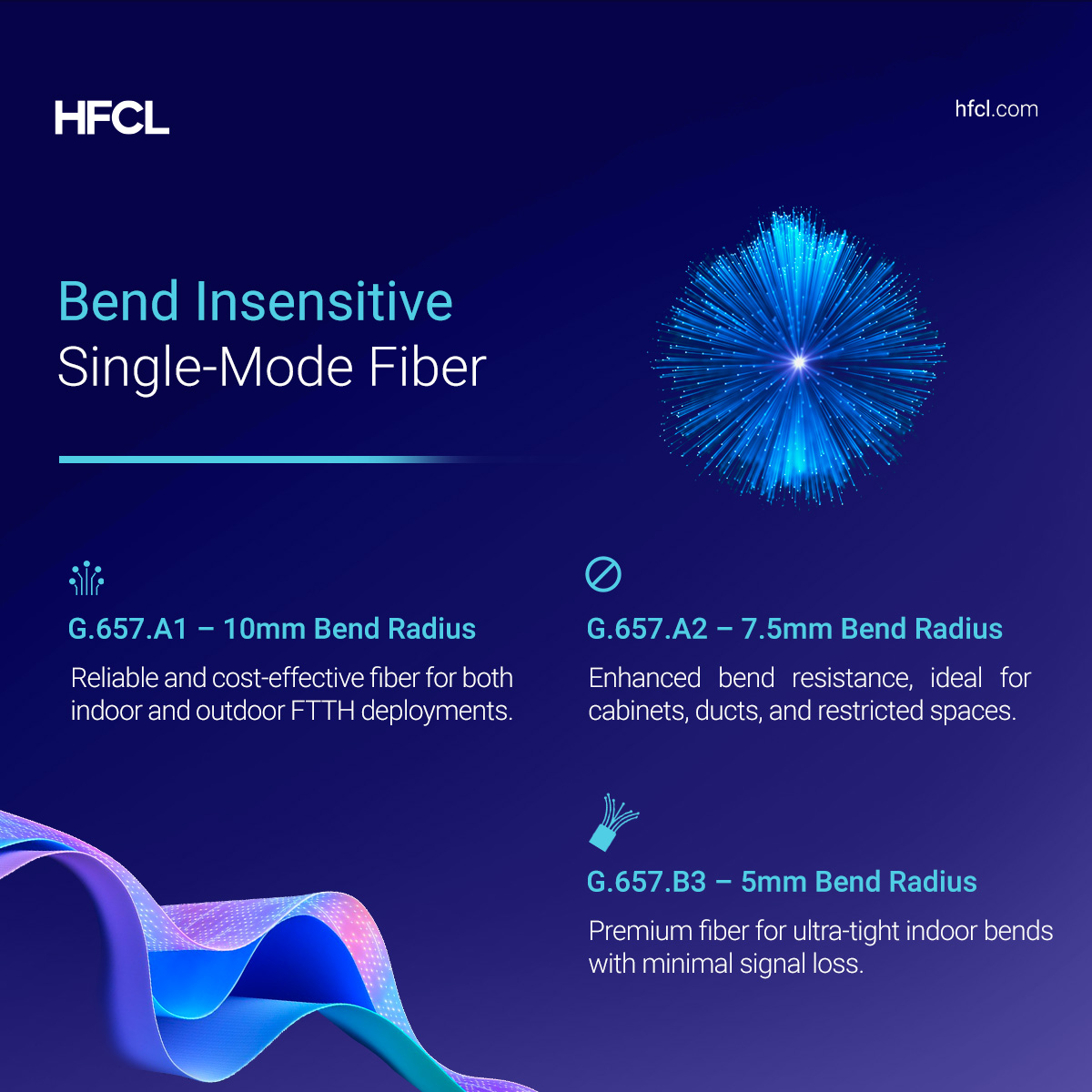
While ITU-T G.657.A1 fibers have a bending radius of 10mm, ITU-T G.657.A2 fibers come with a bending radius of 7.5mm. Both have the same inner and outer core diameters of 9μm and 125μm, making them compatible with each other. The ITU-T G.657.A1 and ITU-T G.657.A2 fibers are perfect for installation in small cabinets and enclosures with restricted space.
The key difference between ITU-T G.657.A1 and ITU-T G.657.A2 is their bend resistance. While ITU-T G.657.A1 is able to endure tight bends, making it suitable for both indoor and outdoor applications. However, the smaller bending radius of ITU-T G.657.A2 makes it more expensive than ITU-T G.657.A1 fiber cables.
What is G.657.B3 and why is it relevant?
On the other hand, Category B of ITU-T G.657 fiber cables have even smaller bending radii than Category A fibers. ITU-T G.657.B2 has a minimum bend of 7.5mm, and ITU-T G.657.B3 comes with the smallest radius of 5mm, which is the smallest radius for single-mode fibers.
The ITU-T G.657.B3 single-mode optical fibers are typically used for installations in tight spaces in indoor networks.These types of fibers are designed for minimal signal loss when compared with the other single-mode fibers. Since they are compliant with the G.657 standards, they are perfect for installations in constrained spaces without any signal loss. These qualities of low attenuation and bend resistance mean they are ideal for Fiber-to-the-Home (FTTH) deployments, for high-speed and more reliable connectivity.
HFCL offers a range of high-quality fiber optic solutions, including bend-insensitive fibers compliant with ITU-T G.657 standards. As a global market leader, the company’s solutions empower network operators across the world to easily and quickly deploy G.657.A1, G.657.A2 fiber cables in confined areas. The wide range of fiber optic cables allows service providers to opt for the most appropriate cable that is in line with their unique requirements. With experience of working with some of the biggest network operators, HFCL is uniquely positioned to meet needs for different types of Bend Insensitive Fibers.
HFCL’s Commitment to Next-Gen Fiber Solutions
At HFCL, we are not just providing bend-insensitive fibers but shaping the future of fiber optic networks. Our R&D teams are continuously working to design fibers with:
- ● Lower diameter and higher fiber density with our 190 micron A1 and A2 fibers, enabling faster deployments in limited duct space.
- ● Enhanced bend insensitivity for reliable performance even in the most challenging indoor and FTTH installations.
- ● Ultra-low loss characteristics, ensuring long-term high-speed connectivity with minimal signal degradation.
HFCL has developed Eka Optical Fiber that exceeds the ITU-T G.657.A1 standards, and are suitable for long-haul transmission with attenuation as low as 0.18 db/km.
With decades of expertise and global partnerships, HFCL remains committed to delivering innovative, future-ready fiber solutions that empower telecom operators, enterprises, and governments to build robust, scalable, and sustainable digital networks.
In closing
Traditionally G652.D single-mode fiber cable is the most widely used fiber cable for communications networks. However, the growing popularity of high-bandwidth-consuming applications has led to the trend of network densification, especially in urban areas, which means that there is a growing requirement for fiber to be installed in limited or constrained settings. ITU-T G.657 compliant bend insensitive fibers, including G.657.A1, G.657.A2, and G.657.B3, are crucial to ensure seamless and quick deployment of FTTH networks in small and confined spaces.