The outbreak of the COVID-19 pandemic put the spotlight on high-speed connectivity as people depend on digital infrastructure to carry out their professional and personal tasks. Fiber-to-the-Home (FTTH) networks have become crucial as a growing number of consumers now work, execute banking transactions, entertain, do online shopping, and learn from home.
European Union (EU) is working towards the target of providing fiber-based gigabit connectivity to all households by 2030. European countries are in the midst of extensive fiber rollout to provide their citizens with high-speed and dependable internet access, as per the vision of Gigabit Society 2025 and Digital Compass 2030.
Fiber connectivity offers unmatched speed and reliability and is crucial to bridging the digital divide. In addition to providing ultra-high-speed broadband and increased capacity, fiber networks enable network operators to better manage the network with simpler network topology. They also offer reduced energy consumption compared to legacy networks, allowing service providers to reduce the costs as well as the environmental footprint of operating fiber networks.
Establishing fiber to the home network in Europe will facilitate massive and quick data transfer, enabling a more sustainable way of life. It also promotes several new use cases like smart city functions, promising an improved quality of life for all. In addition, fiber networks are easily upgradeable offering improvement in network capacity at much lower costs when compared with the deployment costs.
As per the latest data revealed by FTTH Council Europe, the total number of homes passed with FTTH and FTTB in the EU39 reached 219 million in September 2022, compared to 198.4 million in September 2021. The number of FTTH and FTTB subscribers in the EU39 region reached 108 million.
"By September 2022, only 41% of rural inhabitants could enjoy capabilities offered by full-fibre connectivity (compared to the average number of 56% of European households in the EU27+UK region that are covered by FTTH/B networks)," says FTTH/B in Rural Areas 2023 report by FTTH Council Europe.
Mounting FTTH challenges
FTTH deployments in rural areas come with several challenges that differ significantly from those encountered in urban environments. The service providers need to consider several factors while building a new fiber to the home infrastructure to ensure they not only provide the best possible connectivity experience to the consumers but also don't compromise on the cost economics. These challenges often lead to slower deployment, higher costs and technical difficulties.
- 1) Geographical challenges: Rural regions often have diverse and challenging terrains, making the installation of fiber infrastructure more complex and time-consuming compared to urban areas.
- 2) Low Population Density: Generally, in rural regions population/ customers, the population density is low and there are fewer customers per kilometer of fiber. This leads to higher costs per subscriber, thus making it tough for network providers to invest in these regions.
- 3) Infrastructure Limitations: Many rural areas lack the basic infrastructure needed for FTTH deployment, such as existing utility poles or ducts.
- 4) Regulatory and Permit Challenges: Obtaining necessary permits can cause delays in countries with strict land usage regulations.
- 5) Skilled Labour: Specialised skills required for fiber installation, different from conventional copper cable installation, which may lead to longer deployment times and increased cost.
Maintaining the budgets and ensuring the availability of skilled workers can lead to the timely progress of the deployment. Any short or long-term delay can result in an increase in the project's overall cost while depriving the users of the benefits of quality connectivity. In addition, the costs can go significantly up if any civil work requires modifications or needs to be completely redone.
A key challenge in expanding fiber to the home networks in rural areas is the limited return on investments. Fiber deployment demands significant investments and effort, and with low business potential, it hardly makes business sense for the service providers to employ resources on deploying fiber in rural and remote areas. In this context, service providers are grappling with how to deploy fiber optics networks quickly, easily, and cost-effectively to enable people in the hinterland to leverage the digital economy to improve their social and economic position.
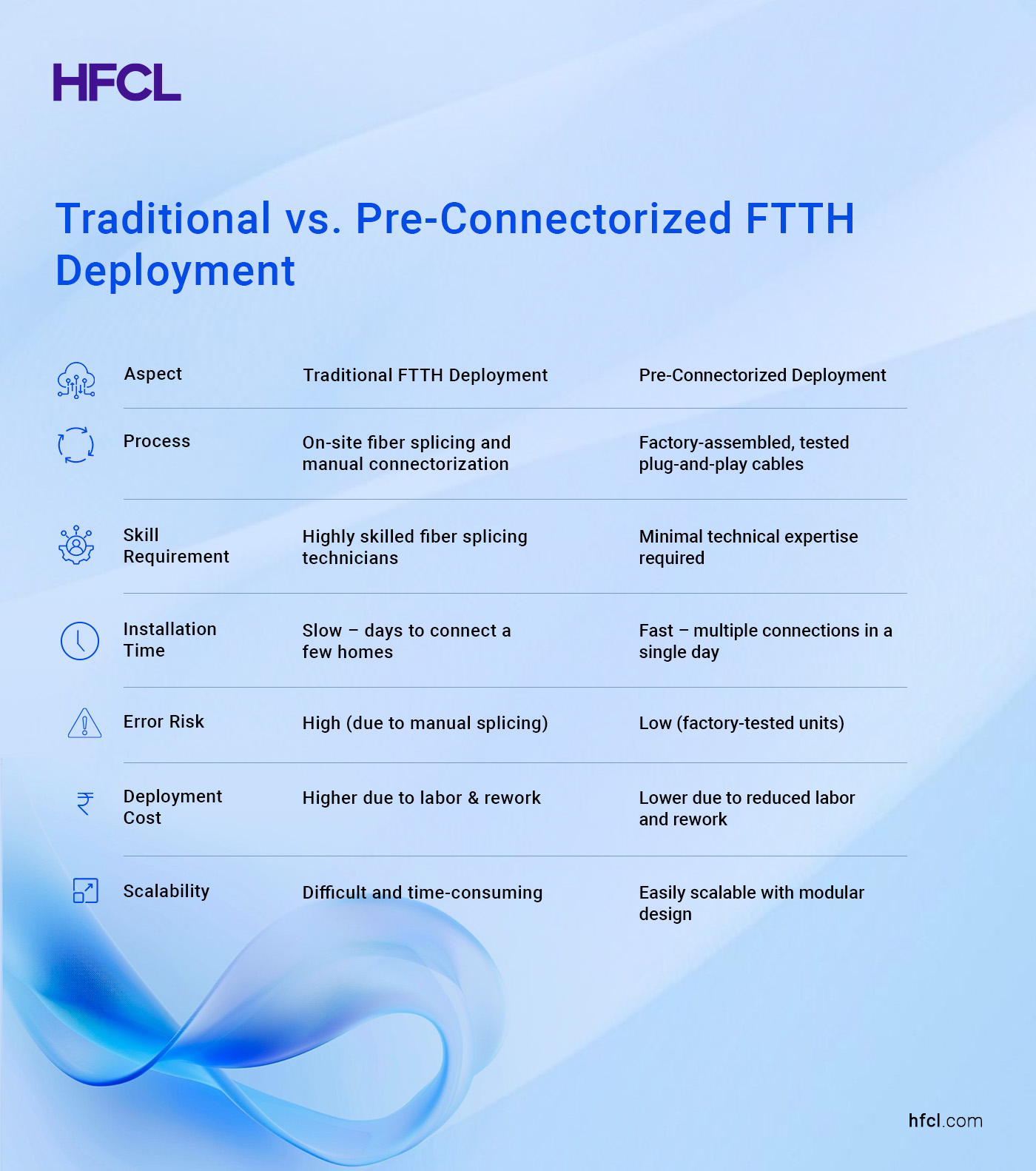
One innovative solution for bridging this digital divide by overcoming the challenges is the pre-connectorisation approach. Pre-connectorization can contribute to accelerating the pace of deployment. It is helping the service providers quickly and easily deploy optic fiber cables.
Pre-connectorization:
- ● Pre-connectorization involves the pre-assembly and testing of fiber optic cables with connectors in a controlled factory environment.
- ● The pre-assembled units are then delivered to the installation site, where they can be quickly and easily connected.
- ● The traditional method of splicing and connecting the fibers on-site is not only time-consuming but also comes with a higher possibility of errors. Since the cable doesn't need to be spliced in pre-connectorization, it ensures quick deployment and connections while reducing activation failures.
Pre-connectorisation offers a Plug & Play solution where the user needs to ship the pre-made to the site and connect to the destination device. The pre-connectorization approach also brings down the overall deployment cost by reducing labor expenses as well as cutting down the time to deploy. Initially, pre-connectorization was primarily used for the aerial rollout of fiber optic but this is no longer the case.
The efficiency and quality of fiber splicing depend on the technicians' expertise, who are usually in high demand. Fiber splicing requires skilled technicians and specialized equipment, but this is not the case with pre-connectorization. A recent RICS Global Construction Monitor survey highlighted labor shortage in Europe, with 72% of respondents highlighting it as a hindrance to construction activity.
This can be counterproductive to the project's cost, especially in regions with high labor costs. Fiber splicing, then, is one of the biggest challenges faced by the service providers engaged in deploying optic fiber networks.
Pre-connectorization can replace the complicated and time-consuming construction of fiber optic networks for greater efficiency and cost-effectiveness. It makes setting up fiber connection a simple plug-and-play operation, thus significantly bringing down construction time and enhancing deployment efficiency. It also offers greater flexibility and scalability since network operators can easily add or remove depending on the evolving demands of the customer.
In addition, pre-connectorization boosts the quality of the optical fiber infrastructure since these elements have been tested against stringent standards to ensure best-in-class quality.
Advantages of Pre-connectorization approach:
-
● Reduced Installation Time:
Quickly deployed without the need for splicing or connectorization on-site, significantly reducing the time required for installation. -
● Improved Quality and Reliability:
Factory-controlled environment ensures high-quality assembly and testing, minimizing the risk of faults and failures in the field. -
● Lower Labour Costs:
Reduces the need for specialized labor at the installation site, lowering overall deployment costs. -
● Simplified Logistics:
Reducing the number of components and tools needed on-site, which is particularly beneficial in remote rural areas. -
● Scalability:
Making network expansion easier to expand as demand grows. -
● Environmental Benefits:
Faster deployment reduces the environmental impact associated with prolonged construction and reduces carbon footprint by minimizing the no. of site visits and equipment required.
In Conclusion
As Europe progresses towards realizing its ambitious fiber connectivity goals, the service providers can accelerate the journey using innovative techniques like pre-connectorization. Rapid deployment of fiber networks will not only help in digitalization and bridging the digital divide but will also go a long way in bringing down energy consumption and emissions.